

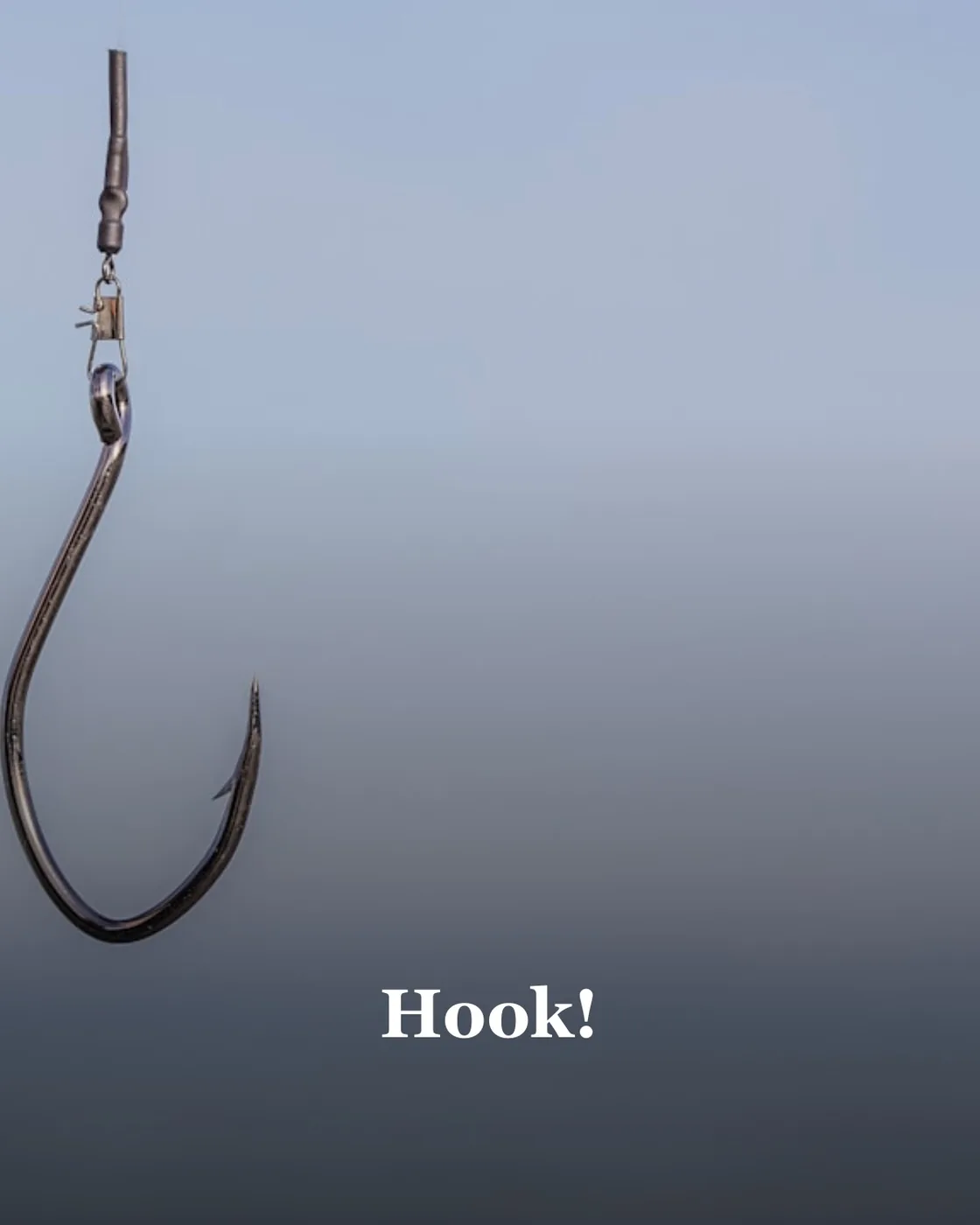
Hook!
Listen to Hook!
Checking audio availability…
Gotcha, didn’t I?
They say you should always start with a good hook, so that’s what I did. And it worked. You’re still reading.
(Who are “they”, those incognito authorities on every topic from aa to Zyzyxia lundelii?
Or, in this case, from fishing to literature?
Because both of those involve hooks.)
Since we’re already using the fishing metaphor, let’s determine an appropriate setting.
Setting is important. It helps the reader become immersed in the story.
Fishing — literal fishing, not literary fishing — requires water.
Ocean? Lake? River? Stream? I’m feeling “stream”.
So, our main character (our only character, unless someone else decides to show up, which does happen literally, when one is savoring solitude in a chosen activity; literarily, when a new character just self-inserts, uninvited), has claimed a perfect fishing spot.
That paragraph wasn’t very clear, was it? Let’s simplify it.
Our main character has claimed a perfect fishing spot, on the rocky bank of a mountain stream.
Now we need to build the character. He? She? Let’s go with “he”. Does he need a name, or is he just a generic man?
We’ll give him a name.
What’s a suitable name for a man who’s fishing by himself on the rocky bank of a mountain stream?
How about… Orvis Bean.
A not-so-subtle nod to a couple of outdoorsy clothing companies. Clever, eh?
They say “Clothes make the man”. (There “they” are again.)
Orvis Bean is probably wearing clothing from the above referenced companies:
Long sleeved knit shirt in a burgundy shade called Maroon Heather, from the Classic Sportsman collection; waterproof pants in a peculiar shade of taupe…
But we’re getting ahead of ourselves. Orvis is more than his outerwear.
Orvis Bean is an average, middle-aged American man, married, with 1.93 children. We’ll round that up to two for convenience. His appearance is respectable but unremarkable; we may mention more details later in the story.
He earns a good salary working in logistics for a shipping company. The job can be stressful; he needs a day off now and then. Usually he spends it fishing.
This looks like an auspicious day for fishing. You might think that means it’s sunny and bright, but Orvis knows fish are more likely to bite when the sky is overcast.
Since it is overcast, Orvis has high hopes for the day. Having packed his gear the night before, he has everything he might need in his tackle box.
He has rigged his line with a hook that looks ineffectively dainty. Being an experienced fisherman, he is aware that trout have small, delicate mouths. They are likely to spot a large hook and regard it with suspicion.
Eyeing the stream and taking note of all the conditions, Orvis calculates where he would like his first cast to settle. He raises the pole, flicks it fluidly forward.
ZZZzzzzzzzz…
A gentle breeze carries the line downstream juuust a tad; it meets the water with a barely audible plip—exactly where Orvis wants it.
Without conscious thought, he lightly touches a finger to the underside of the line. Through the almost imperceptible vibration, he discerns the undulating motion of the crimson and white bobber.
There! He feels a nibble, a cautious testing of the red wiggler artfully concealing a treble hook. Standing very still, he waits for another hit. The fishing line, barely resting on the pad of his finger, is like a six-pound-test fluorocarbon umbilical cord.
Tug…Tug-tug…SET the hook! He’s got it, he’s got it… Reel in! Reel…reel…pull back…reel…reel…pull back… feels like a nice one!
~~~
A substantial trout is flopping around in the creel, which Orvis has placed in a convenient hole at a turn in the creek.
He re-baits the hook and casts again.
ZZZzzzzzzzz…
Tug…Tug-tug…
At this point, we’re going to need some conflict—something to drive the story so we don’t get bored and walk away. Orvis won’t know the difference; he’d be happy to fish all day and take home enough trout for dinner. But we’ll know.
ZZZzzzzzzzz…
Tug…Tug-tug…
Three trout, and it’s not yet noon. He hasn’t checked the time, but he can tell by the position of the weak sun barely peeking through the clouds, still climbing the eastern sky.
The daily bag limit is five, so he’ll have to stop after two more. He doesn’t want to break the flow; he’s having the best fishing day in a long time.
His stomach gurgles, reminding him that he had an early breakfast. He’ll catch his limit and then enjoy his lunch. Or—maybe he should go ahead and eat; then he can clean the fish he’s already caught and put them in the cooler.
We have an internal conflict. Should Orvis eat his lunch, or should he continue fishing?
Without our consent, he compromises. (That’s fine. It happens sometimes.)
Wiping his hands on the “personalized” fishing towel clipped to his belt loop, he scoops an apple out of the cooler.
The fishing towel is a practical present from his mother-in-law, a sweet lady who always seems to come up with gifts that are useful. The “personalization” is her little joke: she ordered it from one of those outdoor clothing companies whose name Orvis just happens to share.
~~~
Enjoying the crisp, juicy apple, Orvis surveys his surroundings from his seat on a large boulder. He’s been here many times—has sat on this very boulder—and has never seen evidence of other human visitors. So pristine is the location that he can believe no one else has ever discovered it. This is his fishing spot.
As soon as that smug notion formulates itself in his brain, Orvis feels an inexplicable discomfort. He’s being watched. We see his body stiffen.
He tries to evaluate the environment which, moments before, had felt peaceful and safe. Now, there is an ominous, heavy feeling—akin to that of a sudden drop in barometric pressure. What, or who, is watching?
Tension, tight as a fishing line caught on a snag, grips the hapless man. It’s a bear in the underbrush! It must be. There are bears around the area. They don’t usually bother—
There’s our external conflict. Man versus nature. Maybe. At least, it’s perceived external conflict. It could just be Orvis Bean’s mind playing tricks on him. Perhaps he has low blood sugar. He should have eaten his lunch.
Speaking of lunch… Bears don’t usually bother people when there’s plenty of food available. The bear (if it was a bear) would have an abundance of trout at its disposal. Orvis had proof of that.
He could offer his trout to the bear. That should pacify it and give him an opportunity to make his departure.
Attempting to appear casual, confident, Orvis slides down from the boulder and turns slightly toward the direction he feels the potential threat is coming from.
Never end a sentence with a preposition.
Edit: Attempting to appear casual, confident, Orvis slides down from the boulder and turns slightly toward the direction from which he feels the potential threat is coming.
We step out from behind the trees, breaking the fourth wall and Orvis Bean’s composure.
There’s the plot twist.
He drops his half-eaten apple and his jaw.
“Good—” I check the time—“afternoon, sir. Here to fish?” I indicate his gear as we present him with our badges.
“Uh… yes,” he answers hesitantly, frowning in puzzlement. He points to the license conspicuously displayed on the bill of his hat. “I, umm, I thought game wardens—or whatever you’re called now… I thought you always wore uniforms.”
“We’re undercover. Special ops,” I explain. You nod.
“Wildlife officers,” you add, answering the question Orvis didn’t exactly ask. “But some people call us fish cops.”
I narrow my eyes, silently censuring you. Don’t get too chummy with the public.
“We’d like to ask for your assistance,” I request.
“All right,” Orvis agrees, bemused but compliant. “Go ahead…”
I slide you a side-eye, reminding you not to let on that there are some things we already know.
“What’s your name?”
“Orvis Bean.”
Again, he indicates the license on his hat. “It’s all on here.”
“Yes, that’s all right, sir. This is just an informal survey. How long have you been fishing here?”
“You mean… today, or how long have I been coming here?”
“Well, both. You’ve fished here before, then?”
“Yes, lots of times. For about ten years. I’ve never seen anyone else here, ever, except for the times my family has come with me. I thought—well, I guess it’s your job to cover the whole territory, so of course you know about it, but I’ve sort of always thought of it as my fishing spot.”
“OK, that answers a lot of questions we won’t have to ask now! So—what time, roughly, did you get here today?”
It’s important to keep characters consistent within a story.
Orvis, working in logistics, doesn’t measure time roughly; he knows the precise time of his arrival.
“I parked my truck up there,” he replies, pointing to the top of the cliff, “at 6:47. By the time I got down here, it was 6:59. I sent my wife a quick text at exactly 7:00, made my first cast at 7:04, and pulled in a nice trout at 7:09.”
Using natural dialogue (another important part of writing), he has given us far more information than we need. On to the next question.
“What do you use for bait?”
“Can’t beat red wigglers!”
“How many fish have you caught?”
“Three. They’re in my creel, over there.” He points.
“Mind if we have a look?” I ask. “We like to keep a record of catches in various locations.”
“Sure.”
We follow Orvis—crunch, crunch, crunch, across the pebbles to the edge of the creek.
“Nice creel!” you observe.
“Thanks. It’s vintage. Split willow. Gift from my mother-in-law.” He squats and undoes the clasps. “I was just thinking about cleaning these before catching my last two.”
The woven willow allows water to seep in, keeping three gorgeous rainbow trout relatively comfortable in their enclosure. You pull out your pocket-size notebook and jot something down—scritch-scritchy-scritch—with an ultra fine pen.
“Thank you,” I say, with a small nod and a brief smile. “Just a few more questions. You clean them streamside?”
“Yes.”
“And put them in your cooler?”
“Right.”
“How long does it take you to get home?”
“Twenty-eight minutes in normal traffic,” Orvis replies.
“And when you get home, how will you prepare them?”
Orvis smiles.
“There’s only two good ways to fix trout. On the grill, or pan fried.”
“Well, Orvis Bean, you enjoy the rest of your day, and your trout supper. You’re not the man we’re looking for. We need to find someone who prefers to poach his fish!”
Story complete!
Enjoyed this story? Sign up to like it, save it, and support the author.


Discussion