

The Violinist
Listen to The Violinist
Checking audio availability…
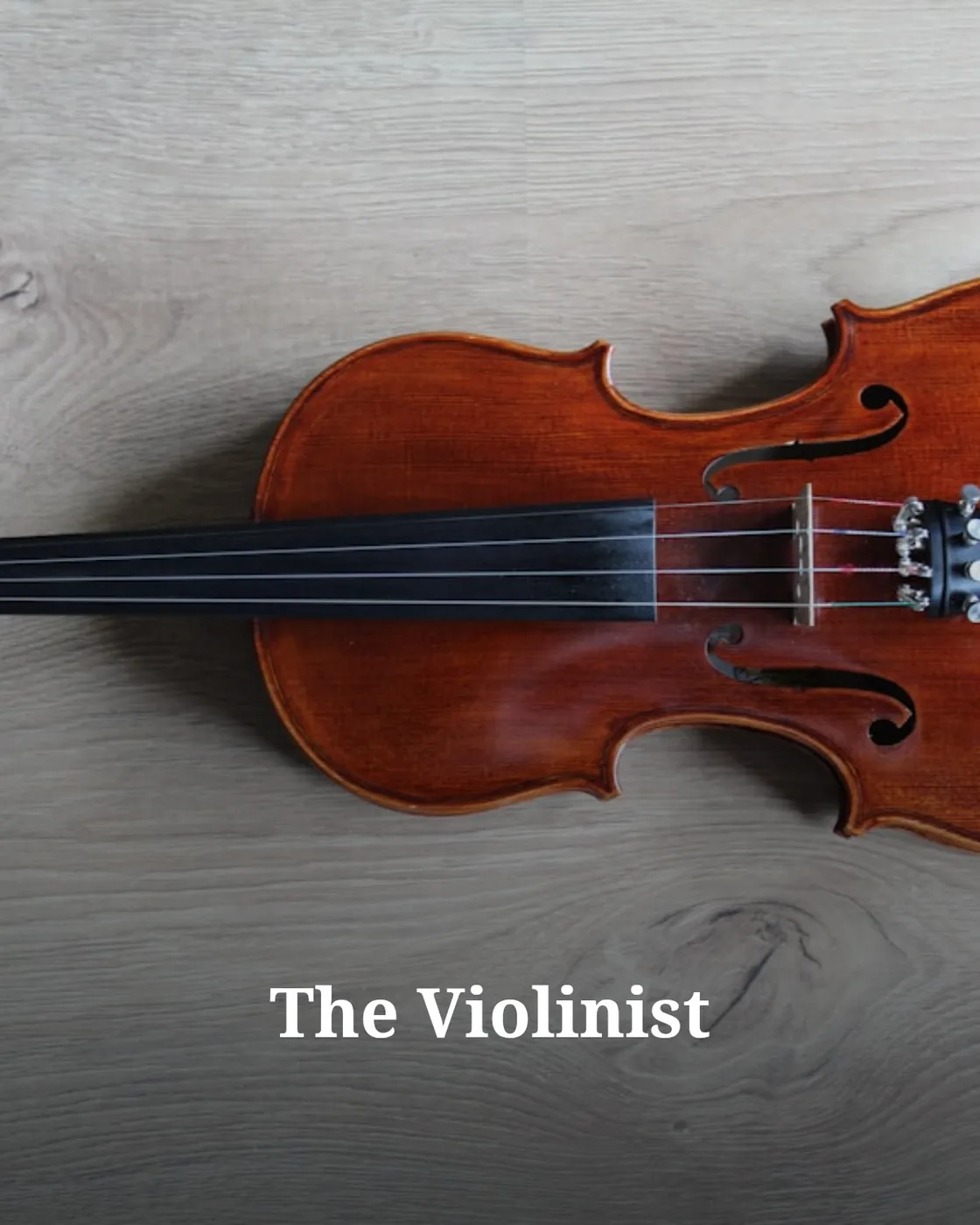
The violin had come from her mother who had it made by Esbern, a soon-to-be master violinist who was only a fledgling violin maker at the time. People had thought it strange that a mistress of the violin would go to a newcomer. But, she must have seen his skill, his potential for the violin embodied perfection, an exquisite masterpiece, and every part was sleek and strong.
She is grateful for her mother’s choice as she stares down at the violin she cradles in her arms as if it were a baby. Its sleek varnished curves and fine silver steel strings reflect the sunlight streaming through the painted windows. It fills her with a quiet joy. Her mother has often told her to keep it within sight and well looked after. She says, “Aletta: Treat it as if it is a young child, cleaned daily.”
The first thoughts in her mind and the last thoughts to leave are of the violin. It leans against the side of the bed, within easy reach. Sometimes, she wakes during the night to find that she has grasped the violin in her sleep. Strumming a string produces clear notes of a type that passes into everything that hears them and nestles in its own special place inside them. The measure of a violin is the sound it produces. The sound of Aletta’s violin is dappled sunlight, lapping waves, cheerful laughter. But it can also produce grief and sorrow. When she plays The Sea’s Lament at festivals or inns, tears flow from the eyes of the listeners.
They say it makes criminals cry, heals addled brains and mends broken hearts. She is not greedy with her music, producing it whenever she can. Walking down through the streets she plays. Weather permitting. If it rains or snows, she shelters the violin inside the confines of her cloak to ensure it is protected. Barons, lords, knights and merchants are eager to have her at their balls and banquets, but she prefers the inns. The innkeepers are happy to have her for they know that once she plays, the inn will be full and she feels like she can have true conversations with the common folk that come to the inns.
She plays with a fervour, her bow feels like the strings. The music twirls and scintillates, the dancing listeners who move faster and faster. Afterwards, someone always comments that it was a night to remember.
Aletta loves it most of all when she comes across a single farmstead as she moves between towns because strangers welcome her as family. “Treating a traveller well brings a bright future” is what they say. For a night she is one with them, sharing their company and a good meal. She pays in tales of the place she has been and music carries her on to the next village or town. Happily, she plays for strangers that she meets along the road, or just for her own enjoyment. Her memories of playing children’s rhymes and music from stories and the joyful responses, help her to carry on going to the next town or farmstead.
On the road, where bandits roam, she is safe for they have no need of a violin and she never carries money for all money is sent back home. The music she makes is better than any weapon. It disarms her opponents in a way that a dagger or sword cannot and they leave her at peace. It also helps that it is blasphemy to attack travelling musicians, doctors and priests. Even bandits follow religious law even if they don’t follow the civil laws. She returns home to Genice every few months. A few days with her parents where she helps to tend the garden but only for a few days as she is always eager to play the violin again before a dancing crowd. When she first picked up the violin her mother had been delighted. She had set a regime of training. Hours of practice every day, strengthening her fingers, increasing her speed and learning to read the simple yet complex language of music.
As a child, Aletta had been eager to learn playing smaller violins crafted by Esbern, those were the only violins her mother let her use. “You should know after strumming a string whether the violin is right for you. It should open a part of you, fill you with peace at its sound and a yearning for it when it fades away.”
She has never told her mother, but all violins make her feel that way; it is the music that is played that carries her emotions, not the violin. If played by the right hands she is carried to tranquil seas or stormy mountains. Her mother has only let her use Esbern’s masterpiece after many years.
Ah, the first day…
“Heh, you with the violin, care for a ride if you play some music.” These words break Aletta’s peaceful dreaming.
He calls out to her from atop his thick brown horse, holding the reins. His face tanned to varnished mahogany, clearly from time in the sun. He stops beside her, his cart laden with goods. “I’m on the way to Holdcroft,” he continues. His voice is clear and carries well. Like a bassoon.
“Sure.” Everyone enjoyed the music. She hoists herself up into the back of the cart and settles down beside bags of grain and a smooth wooden chest. Once the cart starts moving along he talks, about his job as a trader in all sorts: grains, fruit, candles, rope.
“You name it and I’ve traded it,” he says, turning round to flash a smile before he turns back to the road.
He talks about his sister, Mathilda, and their seashore cottage. She opens her case and takes out her violin, hmming agreement at the right points. She tucks the violin in between her neck and left shoulder. The bow positioned on the string, eager to play. She begins with a light tune, It’s a Bright Morning. She doesn’t notice at first he has stopped talking. She moves to A Sea Voyage and then A Bright Flower. The sounds flow out, calm and collected as they fill their minds with images of glistening blue seas, wide meadows and white-tipped mountain peaks. Sometimes their journeys seem linked, sometimes separate but they are both lost. No, not lost, but willingly caught in the weaving of the tapestry – the sights and sounds of the music.
The sun is settling below the horizon. The change in lighting breaks them from their trance-like state. Aletta loosens the bow and tests the strings to ensure they have enough wax. “That was beautiful,” says the driver, his voice raspy.
After taking a drink from his waterskin he continues. “I don’t listen to much music but that was something special, even I could tell. You have true talent.”
Aletta, used to the praise, thanks him, but he must have sensed something in her mood. “I know it’s not much but would you be open to eating my food. It’s just raisin bread and some cheese. If we were at home, I’d treat you to Mathilda’s great pies. Would that be something? Maybe I could owe you a meal. If you ever come by Heatherdale?”
“That would be nice,” she replies absently, as she massages her tense muscles and fingertips. They seem quite stiff. Loosening the tension. She doesn’t want to get stone hands.
Her hands are always slightly stiff after playing. She’s heard of musicians who lost the ability to move their hands at all. She couldn’t imagine the pain, the inability to play. They stop by the side of the road. The driver starts a fire hands her some crusted bread infused with raisins and a few slices of cheese. She eats even though she wants to play the violin. She always wants to play the violin.
Playing and playing… but she needs rest. The music masks the pain in her body but she knows once she sits down for a few minutes she will feel the ache return to her muscles. She never fells hungry. The music nourishes her body better than any food, it keeps her warm. It is magical.
She notices her hands are shaking. After she takes a few bites of the raisin bread, the sweet taste opens the hunger inside her. Keeping her manners, she eats slowly. Measured. In control.
“My name’s Hai,” says the driver. “I have been thinking of your name and it came to me; you’re Aletta, right, the famous violinist. I never thought I would just meet you on the road. The One must be kind looking kindly on me.”
She feels herself blush at his words but the fire must have hidden it as he carries on praising her music unaware of the effect of his words. Something in his words touches her; she responds with a thank you. She feels lightheaded. Why is she acting so strangely?
They pass a few hours talking. Hai details more of his life as a trader. She is happy to listen, musicians have to, as they must listen as they play, open to the needs of those they are playing for. They seem to have been to many of the same places. She learns that The White Goat in the town of Crowfoot has the best ale and good walnut-stuffed bread. She learns of the cost of deerskins and fox fur. She interrupts his flow with a comment. “My favourite thing is freshly-baked bread with honey.”
Hai’s brown eyes seem to shine then, reflecting the last vestiges from the dying embers. “I have some honey from my hives, it tastes amazing.” He rummages in his bag and passes Aletta the jar and a slice of bread. She opens the jar; savouring its rich floral scent. Lavender. She places some in her mouth, feels the flavours explode Rosemary and thyme mixed in with the lavender. Hai smiles; probably at the dream-like expression she imagines to be on her face, as she tries to hand the jar back to him.
“No, keep it. It will go a little towards what I owe you for the music.”
She protests but he places the cold lid in her hands. She feels the heat rise to her cheeks. Must be the honey. They continue talking well into the night, eventually falling asleep under the twinkling stars.
The next morning, Aletta rises to find Hai still asleep. She opens her case and caresses the strings gently as she cleans her violin and applies a smooth sheen of rosin. She always carries a few pieces with her for it can also be used to make a cream if heated and mixed with wax to put on wounds and burns. The thought oddly enough makes her smile. She could be the healing violinist. She’d used it on her herself plenty of times and it had always done the job. She helps to carry Hai’s things and her violin as Hai makes sure everything is on the cart. He did say, “I’ll do it” but she told him it was the least she could do.
Looking at the sun it is still early. Its rays shine through the scattering of clouds.
At least no rain. She stretches her arms and fingers, working through the exercises, making sure her fingers are supple and not locked. It happened once when she was new to it. She had been playing for hours and hours every day and suddenly her fingers had locked and refused to move; hovering over the strings. Her mother quickly noticed.
Aletta still remembers when her mother had opened her eyes and looked right at Aletta. Her brown eyes so calm. Without speaking she had come over and had taken the violin from Aletta and carefully placed it in the case. Clasping her hands she had simply said, “Don’t worry, it means you need rest.”
Upon her mother’s touch, control had leapt back into her hands. She had hurried back towards the case eager to play, but her mother took the violin and started cleaning it, a clear sign that she would not be able to use it for the rest of the day.
“Do you want to eat now or once we get going?” It’s Hai’s voice. “I didn’t know if you are hungry or not. I normally don’t eat till later in the day.” He holds a piece of bread in front of her.
She looks at him for a few moments before she replies. “It does not matter to me but thanks for asking.” She flashes a quick smile and then climbs onto the cart, to hide the heat she feels rushing to her cheeks. Hai attaches the horse and they set off.
While they trundle along; well-travelled roads now smooth, weaving their way through meadows and fields, they exchange stories of their past journeys. Thoughts of home linger. As they enter a forest, the chirping of the birds and the gentle rustle of the wind brings them back as if from a trance. Hai then asks her, “Could you play your violin again?”
Happy to oblige, Aletta opens her case and rests the violin on her shoulder. She plays a tune that matches the eloquence of the birds. Their sounds seem to merge and grow into something new. The gentleness of the violin melts into the keenness of the birdsong. When it ends, they look ahead. The bright green of the trees, a lone dandelion by the side of the road. Dandelion? But it has a golden hue as if the music had enlivened its colours.
Hai doesn’t say anything but listens as Aletta moves to the next tune and the next each blending with the sounds of the wind and the birds; the trees and flowers; to the sights and sounds of nature that surrounds them. Lost in the music, she doesn’t notice the hoof beats pounding the road. All she knows is a moment later she is jolted from her seat. Her vision becomes a blur of colours and all she can hear is wood splintering. There is a sharp pain in her shoulder and then nothing but darkness.
Aletta doesn’t know how long it’s been when the a loud booming fills her ears. Slowly she opens her eyes and the colour returns. She finds herself surrounded by others, playing a variety of instruments from clarinets to bassoons. Someone is plucking a harp beside her. Only then does she realise that she too is playing, but her arms move of their own accord as if she is a puppet being controlled. She watches her surroundings and sees the elegantly dressed men in tunics and women in ball gowns as they dance to the music. Their footsteps are sure, swift and practised; moving in step with the music and their partner like a well-carved instrument. She recognises this place – it is Baron Ulhart’s ballroom. But she has only played here in a band once. She doesn’t remember getting a message?
Her fellow musicians seem to be staring at her; she feels their gaze and then she can see it their eyes – they hate her. Despise her. Why? This was why she always hated playing in groups.
The music seems to falter. The dancers seem to realise and their steps became less nimble and sure. She sighs and the images fade. She wakes up to Hai shaking her.
“Get up, get up.” He half shouts at her and his blue eyes are streaked with worry.
“Are you alright?” He places his hand on her forehead. “Your temperature is okay.” She feels his cool hand against her skin. She winces as the pain pulses alongside the coolness of his hands. “Sorry.” He withdraws. Bringing her own hand to the pain, she feel a sticky warm substance. Blood.
“Where’s my violin?” A moment later she spots it.
Rushing over, ignoring a wave of dizziness, she collapses next to the already-broken violin. No longer a violin just pieces of wood and string. The love and care of decades are gone.
“I’ll collect the pieces, you rest, Aletta,” he says, but she doesn’t comply. She crawls on her hands and knees desperately gathering up each piece. What is Mother going to say? Can Esbern fix it or make a new one? As they search through the wreckage of the overturned cart, Aletta stops periodically to hold her head. She slowly gathers the pieces of wood and string into a pile in front of her. Her head throbs badly as she tries to fit all the pieces together but how does she know what’s missing? If only she could do magic and reverse this. Make all the pieces come back together. She holds the pieces and wished she could. It is beyond repair. She looks up. Hai is watching her silently. “Did you say something, Hai?”
“No,” he replies, and she returns once more to trying to piece together the broken violin while Hai moves through the wreckage, salvaging what he can of his wares, after checking his horse is at least okay. A roll of sapphire blue cloth, an iron chest, leather satchels. She had been so lost in her worries she had forgotten about Hai. What exactly happened? She waits until Hai has finished before asking.
“Some riders came rushing through; I think there were two but I can’t remember their faces though I am sure I looked at them at the moment. They were wearing bright blue sashes and riding black horses.” He hits a nearby tree with his fist. “I’d chase after them if only I had a horse.” “We could go and find him,” she says.
“You are in no condition to be moving about. Conserve your energy.” He is already moving away. “I will go and see if I can find anything.”
She moves to get up but clutches her head and sits back down. She looks back at the ruin which is her violin and holds her head in agony. It no longer exists. What will she do now?
She watches her tears coating the violin strings; sparkling in the sunshine.
Some time later, Aletta dries her eyes with her sleeve and moves to the pile of things Hai has made. She finds his rucksack and takes out a wrapped loaf of bread and hard cheese. She takes a few bites and feels queasy. She places the food back in the wrapping, leans back and stares up at the sky; watches the clouds. You don’t have a care in the world. Would it be great to be like that just moving along… What can she do now? There is still Esbern. She needs to return home. She can’t hide from her mother. She plays the scenarios in her head. Her mother loved that violin. Had she ever thought of it breaking? Aletta hadn’t ever – but her mother can help. She has enough money to pay for a new violin. She has enough stored at home to pay for a hundred more.
Fear grips her. Would Esbern be able to make such a violin? Her heart pounds and darkness surrounds her as she collapses into sleep.
Aletta’s face is pressed against something warm and soft as she wakes. A shirt? As she straightens to look around she realises she was on the horse, arms around Hai. They are on the grasslands.
Violin? “Stop. Stop.”
The horse stops.
Hai turns; looks at her. “What is it?”
“Where is my violin?”
Hai’s face softens at her words as he gets off the horse and brings out the broken pieces from the saddlebag.
“So, it was not a dream?”
“Yesterday you mentioned that you are from Genice. I thought I would take you home.” Her forehead is in excruciating pain and the last thing she remembers is Hai’s strong hands steadying her.
Aletta wakes up under a woollen blanket, the light streams through the gap in the wall that looks out upon a familiar scene: tall oak trees and large meadows of wheat. The sound of the violin carrying its sorrowful tune enters through the open door – as if lamenting the passing of hers. She tries to get up but her muscles are too weak. She calls out but stops and listens to the music. Will she ever be able to play as she did before?
That violin had been hers; the thing that made her music great. Now she’s just a normal violinist, without a violin. Worse than an untuned instrument at least that has potential. The violin is what made her great, what made her music famous. She sighs and stares at the ceiling. The music of the violin grows until it fills her. It sounds like her violin? A tear trickles along the edge of her cheek. No, it is not the same. Something seems to change, a sudden quickening and the music becomes fast but tempered, as if the player is on an adventure as they control the violin, bending the strings to their will. The music fades and is replaced by her sadness.
She wants to play like that again.
A moment later Aletta’s mother walks in; holding a mahogany violin. Aletta’s eyes brighten. Her violin? Its strings gleam with vitality, but they lack the silver sheen and the shape is less streamlined. Her vision blurs momentarily as she wipes her eyes, but her mother knows her too well. She is standing holding the violin, ready to play. Her eyes say it all: I know how you feel. I know what happened, but you have to get over this. Her mother plays a slow tune, swaying with the music the instant she touches bow to string. She becomes one with the violin producing music but also something more. Unexplainable. That is the thing Aletta has lost. She can only be one with that violin.
No other will do.
“What have you lost but a violin?” her mother says. “You are the violinist. The violin is an instrument. A tool to be used by those skilled enough. The violinist produces the music. The violin can change but it is the desire and the will we put into the music that makes it great. I thought it was something you knew – I have not taught you properly.”
That violin is the heart and soul of her music. How can she make something as great again?
“It’s a good thing that violin broke. Now I see you still have much to learn. Listen, Aletta. It was only a violin.” She pushes the mahogany violin into Aletta’s hands. “Now play, play then you will understand.”
Aletta strums the violin, feeling the hum of the music vibrate through her. Maybe? Maybe? She brings the bow close to the string but her hands shake, the bow is unsteady as it moves across the strings it produces only a scratching sound. She tries again and again but nothing. Nothing.
She places the violin down and bangs her fist on the bed, careful not to displace the violin. Damn, damn. Her fear is getting the better of her. Her mother walks over and takes the violin and bow. “Go for a walk,” she says.
But all the walk does is tell her she has healed from her injuries. She has mulled over her thoughts but it does no good. She walks into the main room and finds Hai at the piano gently tapping the keys beside her mother. His large rough hands are at odds with the delicate music he produces. Her mother plays and Hai follows, copying each key exactly in time a half-second afterwards. Aletta stands and listens from the doorway. Her mother tells Hai once they’re finished, “You have good speed and skill. You could easily learn to play the piano. A few years of hard work and you could make a good living.”
He nods and sits at the piano while he ponders. Hai playing the piano? His bulky frame does not seem to go with a piano – but her mother is never wrong.
Her mother plays The Tale of laila and Kiran, a calming piece that her mother used to play. It tells a classic romantic story of a couple and how they overcame their differences of class and culture. A tune coming from the desert lands. Hai opens up his eyes and tries to follow along but the pace is too fast and after a while, he stops before he ruins the piece.
Aletta finds she can now relax. She can still play. She feels it. A surety. Hai has made her realise she can. Not only that she but she wants to. To connect to people on that level. Her music speaks for her; conveying words and feelings she can’t show. Picking up the violin, resting on the side of the piano, she begins to play.
The shaking has gone. There is a momentary twitch of a finger. She plays, losing herself in the music – oblivious to Hai’s shock at her presence or her mother’s knowing smile. By the end, they have moved through numerous tunes. Hai plays after a while and his notes only add to the symphony.
A sharp pain pulses in Aletta’s forehead. She clutches the violin as she leans on the piano. The music stops. She hears it calling but the pain blocks out everything. She opens her eyes; smiling. So this is what it felt like to be injured? The pain reminds her; she turns to Hai and asks, “What are we going to be doing about your carriage and goods?
He smiles. “I just need to get back home and I can start selling again. I’ll be able to recoup the losses. Overall, I think I traded well for the opportunity to learn music and meet you.”
She frowns and feels the heat rise in her cheeks. Hai touches her forehead. “You need a cold press.” He looks at her mother who gestures towards the kitchen. After he’s gone to look, her mother says, “Great job and a great man.
You should be happy. He’s a good companion.”
Hai returns and presses the cold press onto Aletta’s head. It dampens the pain. He smells like lavenders and mustard. Aletta moves towards the violin, but her mother takes her hand and leads her back to bed where sleep eagerly awaits.
When she wakes up, everything feels the same as yesterday morning. The same music flowing through her. No, faintly, she can hear the piano starting to meld with the violin. A cottage by the sea. Seashells and clear air. She shivers. Then falls back into slumber. This time she wakes to find a bowl of soup and bread by her bed. She eats then sleeps again. She moves in and out of sleep, her days a mix of dreams of a seaside cottage, playing the violin by the sandy shore and a man calling out to her in the distance. She turns but is never able to see the face.
After many days Aletta feels able to leave her bed and heads into the main room. An urge is inside her like a thirst after days in the hot sun. She plays but the music seems incomplete. It leaves her dry. She sits down and stares at the violin in her lap.
“Oh strings and wood and bow, why won’t you give me what I want? To make others feel alive with music.” She falls again into sadness. Hai walks in as she plays, and begins on the piano following the sheet music. As her music grows like a flower coming into full colour, the sounds of the violin crisp and clear and the piano deep and low combined, make something more. She looks into his eyes.
Light blue orbs that fill everything.
Story complete!
Enjoyed this story? Sign up to like it, save it, and support the author.
Discussion