

Coda
Listen to Coda
Checking audio availability…
Coda
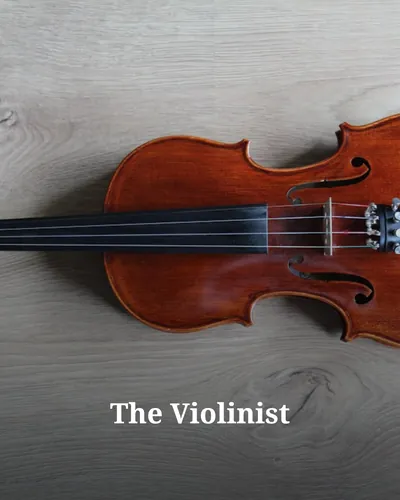
Itan set the bow lightly on the strings, that little, tonal tap tap sparkling in the air, the potential energy of a miracle. Before him was a clearing in the little wood near his new home, the perfect blank canvas for his work. He had once performed these feats for kings, for nobles, for the rich and the famous of every city this side of the ocean; now, he was finally settling down. Now, he could work only for himself, and his wife, Avai. He pressed down just enough, feeling the catch of the bow against the strings, and pulled.
The note which jumped up into the air was pure and sweet; Itan had spent all morning tuning and intonating the large instrument which sat between his legs, and that first note justified the hours of work. It swirled up on the light breeze and ran a lap around the clearing, reverberating for seconds after Itan pulled his bow away. Its energy spent, its momentum slowed and buoyancy diminished, the air no longer heavy enough to keep it afloat. The note drifted down, as a leaf drifts on an autumn afternoon, landing with a final breath upon the bare, grassy ground of the clearing. The note soaked into the soil, nourishing it with a glow of power, small but impactful nonetheless. It was the first note of the spring, the first of their new life here in the cottage by the wood. In palaces and city centers, this moment was accompanied by crowds, parades, fanfare; now there was only Itan and his instrument. He decided immediately he preferred this silence.
As the power of the note dissipated into the ground, it was replaced on the silent air by a small crackling, one usually only heard at its slowest, in the longest of timescales, and therefore rarely recognized. The grass at the very center of the clearing broke open, and topsoil was pushed out of the way, forming a small mound of dark earth. From the center of that mound grew a small, green shoot. The sound was the sound of spring, of life, a sound which the birds and the animals knew instinctively, but which humans had to relearn the long way around. It was the sound of growing. A moment later, a perfect, lone, sun colored daffodil stood proud and bright in the center of the clearing.
At palaces and in cities, Itan would often have returned to work almost immediately after the parades, eager to do more, to layer atop that first note a pre-written orchestra of sound. Finally, though, he had learned restraint, patience, the good which could come of pauses, rests in the music to reset your audience’s ears. The first note was gone from the air, but its effects were still trickling slowly down into the earth, and his future work would be all the stronger if he let the earth reshape itself accordingly. Itan stood with a grunt of pain–old age had its drawbacks, of course–and walked slowly but contentedly back toward the cottage.
The door was open to the mild spring air, and Itan could hear Avai’s happy humming as he approached the little cottage. Containing one floor with only a handful of rooms, the cottage was smaller than any house they had ever lived in before, but they had agreed that was for the best; the size and bustle of cities had worn on them, and they hardly had a use for so much space anyway. The stone and the wood the cottage had been built from–generations earlier, Itan had been told–had been sourced from close-by quarries and forests, and it felt as if it belonged among the streams and trees, the plants and the animals of the countryside, as natural as the sun and the moon which beamed down upon its simple slate roof tiles. Itan smiled as he grew close enough to smell the food Avai was preparing.
A great wooden bowl sat on the counter, to which Avai was adding vegetables and fruit as she chopped, humming in time with her knife. Carrots and celery, nuts and dates, bright red berries and woody looking fungi all went in, joined by chopped herbs, the source of the wonderful smell permeating the kitchen. A simple oil and vinegar dressing had been set to the side, to add to the salad at the last minute before serving, the dark vinegar slowly and naturally pulling itself together away from the oil into a circular blob in the center of the small bowl.
“Play for us,” Avai said as Itan joined her in the kitchen. To play his music for a salad did not evince all of the same magic which it did for a live seed, but Avai swore by his abilities in the kitchen as well as in the garden, and she hadn’t finished a recipe without at least a note from Itan for decades. He settled down in the comfortable chair and set the instrument between his legs once again.
This time, Itan did not bother with the preamble; food might not react as strongly to his music, but it also did not need so much care. He launched right into his old favorite, a folk song his father had taught him as a boy, before Itan had found his talent and his passion and moved away to the big city. The tune was a jaunty jig, and soon Avai was singing along; her voice was much better than Itan’s and he always said it held a magic of its own, despite her lack of the ancient talent which suffused his bow.
A tall man rideth along the lane to the fairgrounds of Joyia
His horse was white and his hat was dark and his eyes they held a spark
And the children ran unto his knee and they begged of the man a story
So he sat atop a stump of tree and spun them all his tale
“A tall man rideth a long way,
His horse and his hat, his home
But not until the man has traveled back again,
Have his horse and his hat come home”
A tall man rideth along the lane away from the town of Joyia
His horse was fed, and his hat on his head, he leaves without a sound
All the children dear and the castles here can keep a man in Joyia,
But his sole intent at the end, my friend, is always to come home, is always to come home
Itan leant his instrument against the table, making sure the leg was nestled safely in the stand, and then joined Avai at the table. It was the best salad he had ever eaten, as were each and every salad she had ever made for him. It glowed with color, with music, and with love.
The next morning, Avai joined Itan out at the clearing. She often watched him work, when she had the time, and now that they had nothing but time, she had vowed to do so as often as her aging joints would allow her to. He sat down on the tree stump he had been using as a chair. For minutes, he merely listened to the land, his eyes closed. Snatches of soft humming from Avai did not interrupt him, for she was a part of the land, now, as much as the trees and the grass and the daffodil. Soon, he was certain the clearing had adjusted to his first note, satisfied with the calm the morning had brought with it. The air was ripe with potential.
Itan began to play. He began slowly, softly, sad notes released lightly from the strings, tiptoeing through the air. This music would be very different from the quick dance he had played over the salad the day before; an entire garden, and entire clearing needed more finesse, a wider range of dynamics. The slow notes, the minor scale they were played in lay the roots for the feel of the piece, and the feel the final product would have. Beauty is nothing without a little melancholy, some nostalgia for what was, and what is no longer.
This would also be different from Itan’s past performances in another way. Before, when this had been a job and when he was being paid by the rich and the powerful, he had never felt comfortable improvising much on his themes; he had always sat down for weeks before a job, writing out each part, weaving notes in between each other with such care as to create the perfect piece of art for his patrons. And he was grateful for the time he had spent doing so; without those hours, those years of practice, Itan would never have gained the skills he needed to do what he was doing now.
As he continued on past the first few notes, Itan passed the extent of his pre-written sheet. The base layer had been laid down; now, atop it, he would put…himself. His playing quickened, the notes became short and sharp, stabbing up into the air, not with violence–that would never do in a garden–but with a vigor which the slower ones had lacked. In his urgent improvisation, these new notes overtook their slowly drifting predecessors, racing toward the ground. The small clearing glowed with energy and life as the music began to work its magic.
Itan slowed down slightly, deliberately plateauing the energy, but now he began to weave the notes more tightly, more complexly. The color of the chords changed, the notes no longer fitting perfectly and harmoniously into each chord voicing. Grace notes slipped in, little flourishes which, had they been held out for full display, might sour on the ear, but which added enough spice to the mix so that the whole composition gained depth, texture. He began to play with the timings of the notes, adding in extra beats, cutting other measures off a beat early, combining different time-feels back to back in an unsteady swinging dance. He heard Avai’s foot tapping unerringly to the new, more complex feeling of the music, proof that his creation hadn’t lost its familiarity despite the oddities, that the music still came from the land, facilitating its return there.
Itan looked around as he pulled the bow back and forth across the strings; the first of the plants had begun to push their way up in response to his music. First came the thorn-bushes, beautiful, shining green leaves juxtaposed against thick thorns, just as beautiful; the base, that first, emotional coat of paint to lay the groundwork for what was to come. Then, vines shot up–the sounds of their growth almost as loud as the snap of a whip–to hang artfully from the branches of the trees surrounding the clearing. Buds popped up from those vines, and soon bunches of small, purple flowers and berries lined each vine; Itan could already see some curious pollinators buzzing around the odd additions to their home.
The complexity begat complexity, and the improvisation begat chaos, in a way he could never have allowed in his former life. The bushes and plants and flowers which shot up in between and around the initial thorny base seemed to be sprinkled at random, but the rainbow of colors of their berries, their petals, the little fruits on the miniature trees pulled the eye along in compelling patterns through the unpredictability. Paths were left through which one might walk, but unlike the squared off, immaculate lanes he might have made for a king’s garden, these wove as if with a life of their own, painting a picture beautiful in its own right with the blank space of the canvas as their paint.
He finished with a quick hail of single notes, which he slowed and quieted deliberately until they were barely audible. As those notes disappeared from the air, their progeny erupted: dozens of yellow daffodils to join their cousin; not a perfect circle of them, and with each facing a slightly different direction, but nonetheless the perfect centerpiece for the living, breathing work of art which now filled the clearing.
With a deep sigh, Itan laid down his instrument in the grass, which now grew tall enough to provide for it a nice cushion. Avai took Itan’s hand in her own. “It’s beautiful,” she said.
He didn’t say a word, but squeezed his wife’s hand. He would add to the clearing, he was sure, throughout the coming summer, and would create one as grand or grander each year to come. But this one was special; the first use of his magic for himself and his own. The herald of the coming spring. The opening of this new, final chapter of their blessed life.
Story complete!
Enjoyed this story? Sign up to like it, save it, and support the author.






Discussion