

The Collector of Beautiful Sounds
Listen to The Collector of Beautiful Sounds
Checking audio availability…
I - The City's Hidden Melodies
The window of Arda's old room in Seferihisar had been like a painter's canvas. Everywhere he looked, there was the green of mandarin trees, the blue of the sea, and the wide, endless sky. He woke there to the smell of iodine and thyme. The sounds he loved most drifted into his room each morning: the calm rhythm of waves touching the shore, the stuttering motor of a fishing boat far away, the rustle of wind through leaves. It had been his kingdom of quiet, a place where he could build enormous LEGO towers for hours without anyone bothering him, disappear into the pages of his favorite comic book, and hear his own thoughts.
The window of his new room in Istanbul faced the blank wall of the apartment building opposite. When he opened it, what entered was not a melody but an orchestra without a conductor, every instrument playing a different song at full volume. The city was a machine that never stopped. In the mornings, while he was still half asleep, the horns began. Through the day they gave way to construction drills, street vendors calling out, and the endless murmur of thousands of people moving at once.
When his family moved to Istanbul because of his father's new job, Arda found that the hardest part was not missing his school or his friends. The hardest part was losing the calm he had known. His ears, trained by the soft sounds of Seferihisar, were always on guard in this city. It did not merely upset him. It made him angry. Just as he was about to fit the most exciting LEGO piece into place, the screech of brakes from the street would shatter his concentration. At the most suspenseful line in his book, a truck would roar past and force him to read the same sentence three times.
His parents saw his restlessness as the ordinary pain of getting used to a new city. 'Look how alive it is, Arda,' his father would say. 'There is a different adventure on every corner.' But how could Arda hear those adventures when there was no silence around them?
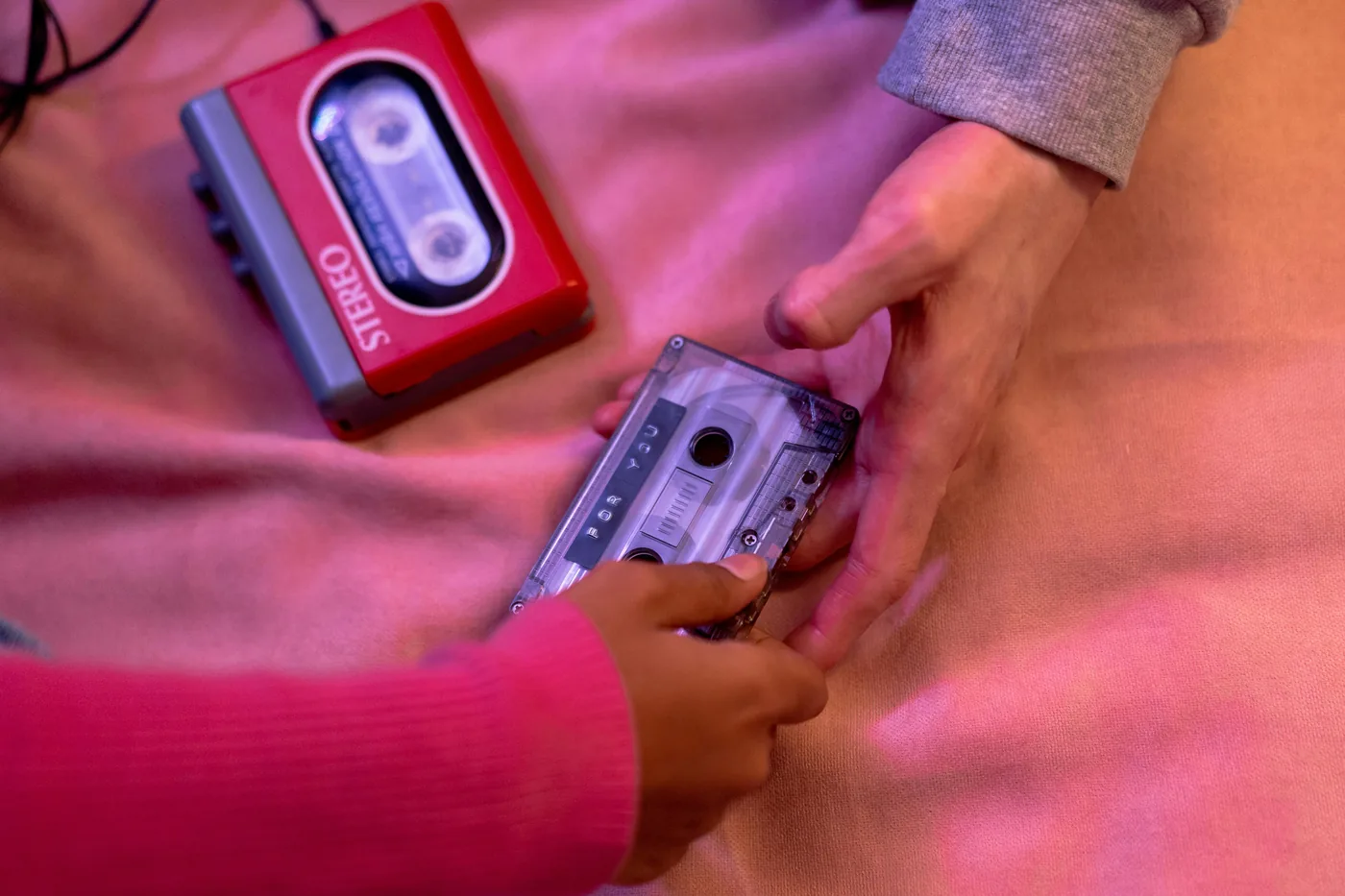
One day, after giving up on his LEGO because of the noise and pacing his room in frustration, he found an old device in the drawer of his father's desk: a small silver digital voice recorder. His father had once told him, 'I used to record lectures with that at university.' A mischievous idea came to Arda. Like a detective, he would record the city's noise criminals one by one, play them for his parents, and prove why he could not concentrate.
Excited by his new investigation, he pressed the red REC button. First he recorded the maddening sound of the drill at the construction site. Then the heavy traffic on the main road. After catching several different suspects, he returned to his room in triumph and put on his headphones.
What he heard was not at all what he expected. Instead of separate, irritating sounds, his headphones released a muffled, crackling, nameless rumble. The recording had failed to capture the character of each sound. It had turned everything into one ugly knot of noise. This evidence would not prove his case. It would only give him a headache. Disappointed, he left the recorder on the desk. It seemed impossible to fight the city.
That night, restless and annoyed, he could not sleep. He lay in bed thinking of their house in Seferihisar and the moonlight glittering on the sea. At last he got up and cracked the window open. It was past midnight, and the city's noisy orchestra had finally lowered its instruments. There was a different kind of silence outside, one Arda did not yet know.
Then he heard a sound he had never noticed before.
It came from far away, but it was surprisingly clear: a cheerful, sweet, rhythmic chime. Ding-ding! Ding-ding! After it came the smooth electric hum of wheels moving along rails.
Arda remembered the red nostalgic tram he had seen with his mother during the day on one of the city's old streets. In daylight, its sound disappeared inside the crowd. But now, in the quiet of night, the tram bell sounded like the voice of a storybook character saying to the city, 'I am here, and everything is all right.' It was not angry like a horn or frantic like a siren. It was bright and inviting.
Arda snatched the recorder from his desk. He returned to the window, pointed the microphone toward the night, and waited. When the tram approached its stop and rang its bell again, he pressed the red button. Carefully, he captured the sweet chime and the soft roll of the wheels that followed.
Back under the blanket, he put on his headphones and played the recording.
Ding-ding!
The sound shone inside his ears. When he closed his eyes, he imagined himself inside that red tram, gliding gently through streets filled with lights. The sound seemed to whisper that he did not need to fear this city; it, too, had its own small and lovable melodies. For the first time, Istanbul had given him a secret.
In that moment, Arda's game changed. He would no longer be a detective hunting noise. He would become a collector of the city's hidden and beautiful sounds.
His new mission brought a different kind of joy to his days in Istanbul. The first piece in the collection was ready: Recording No. 1: The Bell of the Nostalgic Tram.
The next day, he began listening to everything around him with the attention of an explorer. On the way home from school, he noticed the chestnut seller on the corner turning roasted chestnuts over the coals. They made a rhythmic little snap-pop sound, followed by a warm, sweet smell. He pulled out the recorder at once: The Chestnut Seller's Happy Song. That evening, while his mother read in the living room, he heard the only sound that interrupted the quiet: the soft whisper of a turning page. He added it to his collection: Mother's Book Page. Over the weekend, he recorded a cluster of sparrows on his windowsill, chirping frantically over a single piece of simit: Simit Squabble.
Slowly, the collection filled with the warm, living sounds that hid behind the city's noise. Arda no longer tried to escape the noise. Like a naturalist searching for a rare butterfly, he began looking for the most colorful moments of quiet inside it. One day, while listening to his recordings in his room, the familiar construction noise started outside again. Before, he would have become furious and covered his ears. This time, he did something different. He kept his headphones on. He closed his eyes. As he listened to The Bell of the Nostalgic Tram, the drilling outside drifted farther and farther away, lost its meaning, and became only a background sound he did not have to follow.
That was when Arda discovered something important. Silence was not only the absence of noise. Sometimes it was the ability to choose the right sound and let all the others fade. He was not merely collecting sounds anymore. In this vast new city, he was beginning to collect his own inner calm. What he did not yet know was that this precious collection would not remain his secret for long. Soon, it would become strong enough to change an entire neighborhood.
II - The Song the City Forgot
Arda's new game had turned him into an explorer. The streets of Istanbul were no longer a noisy, exhausting maze. They were a vast adventure park, filled with hidden treasures waiting to be found. His voice recorder was his compass. His headphones were his most valuable treasure-hunting tools. His mission was simple: to find the modest instruments playing quietly on their own, half-buried inside the city's loud orchestra.
One of his expeditions took him to the old public library in the neighborhood. It was always neat, always calm, and the moment he stepped through the door, the chaos outside seemed to be cut away with a knife. In its place came a different smell: paper turning yellow with age, polished wood, and the quiet dignity of books. Arda had not come to read. He had come to listen. The library's silence was not empty. If one listened carefully, it had a living rhythm of its own.
He sat at one of the tables near the back, pressed the red button on the recorder, and closed his eyes. New pieces entered his collection. First, he caught the clear, solid sound of Ms. Feride stamping a returned book with its due date: ka-dunk. It was the sound of order and time. Then he recorded the grave rustle of an elderly man turning a page in a large bound encyclopedia. That was the sound of knowledge. Finally, he added the sleepy little squeak of Ms. Feride's wheeled cart as she pushed it down the aisle to shelve the books. That was the sound of care and work.
Arda was still under the spell of these new sounds when a gentle shadow fell across his table. He looked up and saw Ms. Feride smiling at him. With her silver hair and the wise lines around her eyes, she looked as if she had read every book in the library.
'Hello, young man,' she whispered. 'I see you are listening to the library's music, too.'
Arda froze. He had expected to be caught, maybe even scolded for being strange. But there was no judgment in Ms. Feride's voice. There was only the warmth of someone who recognized a secret. Hesitantly, he told her about his project, the Collection of Beautiful Sounds: the noise of the city, the calm of Seferihisar, the tram bell, the chestnut seller's song.
Ms. Feride listened with great care. 'Do you know what a beautiful thing you are doing?' she said. 'You are not only collecting sounds, Arda. You are collecting the spaces between them. The moments people forget to notice. Small moments of happiness. Your collection is really a collection of memories.'
Her words opened a new room inside Arda's mind. He was not merely a hunter of sounds. He was gathering memories. The idea made him even more excited, and it pushed his search into more personal, more tender places.
His next stop was his grandmother's house. As always, she was sitting in her rocking chair by the window, knitting. Arda sat quietly beside her and started the recorder. He captured the rhythmic click of her wooden needles touching each other. To Arda, that sound meant childhood. It meant safety. It meant the warm sweaters she had made for him. He named the recording Grandmother's Gentle Clicking.
When he stopped the recording, he told his grandmother about the collection. Like Ms. Feride, she understood him with a seriousness that made him feel taller. Her eyes lit up. 'Your late grandfather had sharp ears, too,' she said. 'We would look out at the sea, and he would close his eyes and say, Listen. That cry is a seagull, but that one is a cormorant gliding low. Their wings sound different. He did not only look at the world. He listened to it.' She smiled. 'Your ears must be sensitive like his. You are collecting stories that might otherwise disappear.'
Those words gave Arda strength. What he was doing was not merely a child's game. It felt like the continuation of a family gift, a kind of attention passed down to him. His collection now held not only sounds and moments, but family stories as well.
He grew braver. He began exploring parts of the city he had never visited before. After the crowds thinned in the Grand Bazaar, he recorded the echoing clang of a shopkeeper pulling down a metal shutter. Outside an old boza shop in Vefa, he captured the sweet indoor murmur that spilled through the doorway. On the deck of a ferry, he separated the deep thud of waves against the hull from the cries of gulls overhead and added it to the collection.
One night, hoping to make a clearer recording of the tram bell, he got permission to go to the nearby tram stop. The air was cool, and the streets were almost empty. While he waited for the tram, he began listening for the sound he had once heard only from his bedroom window. Instead, another sound reached him.
Crickets.
He realized the sound was coming from a forgotten vacant lot beside the tramline, fenced off and covered with tall weeds. It was a tiny piece of wildness trapped between buildings and asphalt. The familiar, peaceful sound from the garden of their old house in Seferihisar was still alive here, like a miracle in the heart of the city. The discovery shook him with happiness. This sound was a bridge between his old life and his new one, an olive branch reaching from the kingdom he had lost into the world he was still learning to live in.
He took out the recorder and held it toward the lot through the fence. For several minutes he recorded that hidden chorus. This sound was different from all the others. It was not made by people. It was not the sound of a machine. It was the sound of life itself: the sound of resistance, of being forgotten and refusing to disappear, of nature's quiet stubbornness. It would be the most precious piece in his collection. He named it The Song the City Forgot.
He returned home filled with triumph. His collection felt almost complete. He had found the city's human-made melodies and its secret natural ones.
But his joy did not last long.
A few days later, on his way home from school, he passed the lot he loved so much. Something had changed. A large white banner had been tied to the fence. Arda walked closer and read the cold official words printed on it.
WARNING: CONSTRUCTION WILL BEGIN ON THIS SITE SOON. PARKING GARAGE AND BUSINESS CENTER PROJECT.
Arda stood frozen in front of the banner. In the distance, a truck's brakes screeched, and the sound seemed to pierce his ear from right beside him. The city's noisy machine had set its eye on his most precious island of quiet. The small, defenseless home of the crickets, that irreplaceable night song, was going to be buried forever beneath concrete and iron.
For the first time, noise did not merely disturb him. For the first time, he feared it. This noise was not only going to hurt his ears. It was going to destroy something in his heart, and the most valuable piece of his collection with it.
He closed his hand around the small silver recorder in his pocket. In that moment, it felt terribly light and powerless. How could a child with a tiny device in his hand stand against bulldozers and cement mixers?
The problem was no longer just his search for peace. It had become a rescue mission. Arda understood that collecting and exploring were not enough anymore. He would have to become a protector. A protector of beautiful sounds.
III - The Chorus in the Garden
For days, Arda looked at the banner with its cold official letters as if it were a monument to something already lost: PARKING GARAGE AND BUSINESS CENTER PROJECT. Those words felt like a bulldozer aimed at the most precious piece in his collection, The Song the City Forgot. At night, when he listened to the crickets, he no longer felt only peace. A sadness entered the sound. It was as if he were hearing the last words of a friend he was about to lose. He held the recorder tight and went to the vacant lot night after night, trying to trap those final notes forever. But he knew that the recording of a sound was not the sound itself, just as a photograph of a flower could not give back its scent.
In his first moment of helplessness, he told his parents. His father looked at the photograph of the banner and then at Arda's worried face. He sighed. 'My dear boy,' he said, placing a hand on his shoulder. 'I know this upsets you. But these things happen. That land belongs to someone, and they can do what they want with it. There is nothing we can do.'
That sentence was the one Arda feared most: There is nothing we can do. It was the saddest sentence in the adult world. Did growing up mean learning to watch beautiful things disappear and accepting it? Arda did not want to accept that.
He thought of only one person: his confidante and guide, Ms. Feride.
The next day, he rushed to the library. Ms. Feride noticed the shadow on his face at once. They sat together at the small table in the back room. Arda told her everything. Then he handed her the headphones and played the recording of the crickets. Ms. Feride closed her eyes and listened for a long time. When the recording ended, she removed the headphones slowly. There was sadness in her smile, but also wisdom.
'I understand what a precious thing you have found,' she said. Then she asked the question that unlocked everything: 'Why do you think the people in the neighborhood, or the developer who bought the land, do not care about that lot?'
Arda thought for a moment. 'Because,' he said, 'they only see an empty lot. Weeds and trash. They do not hear the music inside it. They do not know it is alive.'
Ms. Feride nodded, as if that was exactly the answer she had been waiting for. 'Then our task is clear, Arda. We must not merely tell them. We must let them hear the life inside that place.'
The idea cleared the clouds of helplessness from Arda's mind like sunlight. Let them hear it. That was something he could do. That was his power. They would organize a Listening of Beautiful Sounds. It would not be just an event. It would be a rescue operation.
They began at once. Ms. Feride gave them a corner of the library. Arda became not only a collector, but a curator and organizer. First he recruited his friends, Cem and Aslı. He explained the project and played the cricket recording for them. At first they thought it was strange. But once they heard the sound, they understood what Arda was trying to save and joined the team with excitement.
Aslı drew beautifully, so she designed the posters. In them, a single cricket stood beneath enormous buildings, with the words: ARE YOU READY TO HEAR THE CITY'S WHISPER? Cem was good at organizing things. He visited the neighborhood shops and asked permission to hang the posters in their windows. The baker, the greengrocer, the barber - all of them agreed to support the unusual but charming event. Ms. Feride borrowed twenty pairs of headphones from a nearby school. Arda's task was the most delightful: arranging the order of the listening journey.
He sorted the recordings carefully, like a playlist. He wanted to lead people away from the city's noise and gradually into the depths of quiet. First he would welcome them with the warmth of home: Mother's Kindness, the sound of dough being kneaded, and Grandfather's Time, the ticking of a wall clock. Then he would show them the friendly face of the city: The Bell of the Nostalgic Tram and The Chestnut Seller's Happy Song. After that, they would step toward the heart of calm: Page Whisper in the Library and Rain Jazz on the Windowsill. Finally, he would take everyone to the vacant lot, to that magical night. At every sound station, he wrote a small note telling the story behind the sound: This is the sound of love hidden inside warm dough. This is the sound of time moving with patience and dignity.
On the day of the listening, the library corner was almost unrecognizable. Cushions covered the floor, the lights were dimmed, and beside each cushion lay a pair of headphones and a small note. Arda waited for the guests with his heart pounding. He did not expect many people. Ten or fifteen would be enough.
But slowly, the corner of the library filled. The grumpy man from upstairs who was always complaining, the tired young doctor couple from downstairs, İsmail the baker, Mr. Hasan the barber, and many neighbors Arda did not know had all come because the children's strange poster had made them curious. Among them was a young man in neat modern clothes, carrying a tablet. Arda did not know him. He was Mr. Fikret, the son of the owner of the construction company and the architect of the project. Curiosity had brought him, too.
After Ms. Feride gave a brief welcome, she handed the floor to Arda. He looked at the paper in his hands, then stopped reading and spoke from his heart. 'Hello. We all live in the same city. Sometimes this city can be very loud. But I noticed that beautiful sounds are hidden inside that noise. For a few minutes, I am asking you to forget the noise and listen with me to the city's secret whispers.'
People put on the headphones, some puzzled, some amused, all curious. Then the magic began.
Arda moved between the stations and watched their faces. He saw the hard expression of the grumpy old man soften as he listened to the clicking of his grandmother's knitting needles. He noticed the tired woman doctor close her eyes and smile at the recording of a cat's purr. Shoulders loosened. The hurried look of the city faded from people's faces and was replaced by a quiet, peaceful smile. They were not only listening to sounds. They were finding forgotten memories and lost feelings.
At last, the finale arrived. Arda connected the final recording to the main speaker. 'Now,' he said, his voice trembling, 'I want you to close your eyes and listen to the song hidden inside the empty lot beside our homes - the place we thought was only weeds and waste.'
The clear, rhythmic, endless song of a single cricket filled the room. That one modest sound reached every corner. No one opened their eyes. It carried them to summer nights from their childhood, to villages they had visited, to balconies under stars, to moments when they had been less tired and less hurried. When the recording ended, the room was silent in a deep and respectful way. To Arda, that silence was more beautiful than any sound he had ever collected.
When applause broke out, Arda's eyes filled with tears. Then Mr. Fikret came over. His eyes were wet, too. 'I...' he said, struggling to find the right words. 'I did not know that place had value. We looked at it and saw square meters and cost. But you heard its soul.'
The listening became a snowball. It rolled and grew. The next day, the neighbors began talking among themselves and decided to start a petition. It was no longer only Arda's fight. It had become the neighborhood's shared cause.
A few weeks later, the terrible banner was removed from the fence. In its place, the neighbors and children hung a colorful sign they had made together:
WITH YOUR SUPPORT, THIS SITE WILL BECOME OUR NEIGHBORHOOD'S GARDEN OF BEAUTIFUL SOUNDS.
Mr. Fikret had persuaded his father. The company moved the parking project elsewhere and, as a gesture of goodwill, promised to help build the garden.
The vacant lot became a small, welcoming garden with wooden benches, bright flowers, and a narrow walking path. Arda sat on one of the benches. He no longer held the voice recorder. He did not need it. He closed his eyes and listened. The familiar hum of the city still drifted in from far away. But before it now rose a stronger, happier chorus: the faithful musicians of the night, the crickets. They sang as if they knew they were safe.
Arda was no longer running from noise. In the middle of the city, he had found a refuge of calm and helped protect it with his own hands. He was not only a collector of silence now. He was someone who could help beautiful sounds take root and share them with others. Most important of all, he had found the calmest, clearest sound inside his own heart.
Story complete!
Enjoyed this story? Sign up to like it, save it, and support the author.






Discussion