

Be Where Your Feet Are
Listen to Be Where Your Feet Are
Checking audio availability…
The shop didn't have any sort of sign.
That was the first problem, and the one that had kept Fraser walking past it for three weeks. There was no name above the door, no menu in the window, no nothing. There was, taped to the inside of the glass, a sheet of brown card with the words NOW OPEN written on it in a hand so casual it could have been a joke. He wasn't sure, the first time he passed, but he suspected it may be a café, and his uncertainty about this had become, over twenty-one mornings, the controlling fact of his commute.
Two people inside, always, that he could make out in the glare. He didn't want to slow down enough to look properly, because slowing down enough to look properly was the sort of thing a weirdo would do.
There was no chalkboard with prices on it. There was no chalkboard at all, in fact, just a small slate by the door with one phrase chalked on in a careful hand: Be where your feet are. Fraser had been, on every alternating morning, exactly where his feet were, which was on the pavement outside, looking at the door, and then, at the last possible second, deciding to be where his feet would shortly be, which was Costa, four minutes down the road.
The truth, which Fraser admitted to himself in private and never out loud, was that he wasn't sure he even liked coffee. He drank it. It woke him up. It also sent him, with the brisk efficiency of a small industrial process, to the toilet within the half hour, which was its own routine you didn't ask too many questions about. The taste, when he really paid attention to the taste, was a bit like licking the inside of a kettle. He suspected, mildly, that nobody actually liked coffee, that the whole business was a costume the world had agreed to wear, and that one day someone would notice. In the meantime he ordered a cappuccino, which had enough milk in it to disguise the kettle. Cappuccino was his word. He had learned that word. He could say it with his ears closed.
Croissant, however, could fuck right off.
What he was less sure he could say was whatever this place would call any of it. A place with no sign and no menu and a chalkboard that said Be where your feet are might very well call a cappuccino something daft. He had been, once, into a Starbucks where the sizes were tall, grande, and venti, and had stood in the queue with the slow horror of a man realising that none of these words meant what he had thought they meant, and had got to the front and asked for "a medium" with the small sweat of a man trying to defuse a bomb by guessing. The girl had stared at him. He had considered, briefly, pretending not to speak English. He had got out alive with what he thinks was a latte. He had not been back.
He had been, since he was twenty-two, the man who reads the menu and orders the second-easiest thing. The reason was a single moment that still arrived unbidden, mid-sentence at work, brushing his teeth, paying for petrol. A dinner he had been keen to seem at ease at. A girl across the table he was trying to impress. And I'll have the crew-dites, please, he had said, with absolute confidence, to a waiter who had not blinked. It was his pal beside him who had done the damage, the smallest possible movement at the corner of his mouth, half a second of judgement, then nothing. The waiter had moved on. The conversation had moved on. The world had moved on, in fact, in every direction except inside Fraser, where the ground had gone clean from under him and the back of his neck was a hot wet thing and the air around the table had thickened to glass. Six years later he could still see it. Six years later he could still see the smirk.
So three weeks, then. Three weeks of walking past, not knowing if it was a café, not knowing what it would call a cappuccino if it was, not knowing what an affogato was, the only word he had managed to make out on a board behind the counter through the glass. It sounded Italian. It looked, in his hopeful brain, faintly like avocado, which was wrong in every direction at once but which his brain, by way of helping, kept offering up. Affogato. Avocado. It was the kind of small useless wordplay his head made when it didn't want to think about the actual problem, which was that he was going to have to say the word out loud one day and probably not today.
He didn't know what was different about this morning. The drizzle, maybe. The fact that the bus wasn't for ten minutes yet. Or the small chalk slate by the door, which today, for no reason, looked less like instruction and more like a question.
His hand was on the handle. He couldn't remember telling it to do that. His chest had gone tight in the particular way it went tight before he didn't do things, and he could feel, behind him, the long warm familiar pull of the four minutes to Costa, the known cappuccino, the server who never wasted any time with small talk. He pulled the handle. He stepped through it like stepping off the edge of a cliff, no turning back, and the door swung shut behind him with a small final sound that he felt in his teeth.
The bell went. The warmth came up off the floor at him. There was, immediately, the smell, which was the best part of the whole coffee business, the smell, not the drinking, and Fraser thought, aye, this bit, this bit I like.
A woman behind the counter looked up at him and said hi, in the voice of a woman who was, for some reason, glad to see him. Her hair was up in the kind of soft up that wasn't quite up, the kind that had been put together quickly with one hand while the other did something else, with a loose strand at the side falling along her cheek that she had, plainly, decided to let fall. She was drying a cup.
"Hi," said Fraser, who had not rehearsed hi.
"What can I get you?"
He had seven things ready to say, and they were all in a queue, and the queue had jammed. He heard himself, instead, say, "It's, eh, it's nice in here." And then he heard himself, with the small dawning surprise of a man hearing his own voice come back at him from a tape recorder and not hate it, register that it had come out cool. Slightly low, slightly easy, like a man who walked into places without signs all the time.
"Aw, thanks. We've only been open a few weeks. Are you from around here?"
"Aye," said Fraser, and the word was out and shut behind him before he had time to give it any of the rest of the answer.
There was a small pause, the kind that is everyone's fault and no one's, and she let it stand, and then she laughed softly at nothing in particular, and he laughed too, also at nothing, and they were, for a second, two adults laughing at nothing in a café that did not have a sign.
"What can I get you?" she said, gently.
"Oh, eh." He paused, with what he hoped was the deliberate pause of a man considering his options, and not the panic-pause of a man who couldn't currently remember his own mother's name. He let it sit. He frowned thoughtfully at a point above her left shoulder. "Ah, I'll just have a cappuccino, please."
"For here or away?"
He said something. He wasn't sure, even as he said it, what it was. Some sound that started as to go and ended as something else, a mumble, an exhalation, a small surrendered noise. She nodded. She turned to the machine.
The bell went behind him.
A man came in. Fraser felt him arrive in the small adjustment of the room's air, the slight shift of attention, and he half-turned, the small instinctive turn of a man not wanting to be in someone's way, and the man stepped up to the counter alongside him, light-coloured running gear, headphones around his neck, a face like he ran 10k for fun before work and would shortly mention this.
"Oh nice," the man said immediately, looking past her at the neatly positioned packages of coffee on the shelf, "is that Steampunk you've got?"
"It is, yeah," she said, working.
"Sound. Can I get a flat white, double shot, oat, and one of the cardamom and pistachio cruffins, are they today's?"
"Of course!"
"Lovely."
Fraser, who had paused in case he wasn't certain about the word cappuccino, stood beside this man with the small still face of a man who had watched, in real time, an entirely different species order coffee. He did not know what a Steampunk was. He did not know what a cruffin was. He had not been certain, until ninety seconds ago, that he knew what a flat white was, and now he wasn't even sure of that. He moved, very slightly, an inch sideways. He looked at the slate. Be where your feet are. His feet, he now felt, were on entirely the wrong street.
She made his cappuccino first, which he registered with a small grateful flare, and slid the cup across the counter to him with a quick smile, a split second before turning to the next order, and the smile, having only been on her face for the split second, stayed on his for considerably longer.
He was still holding it on his face when his eyes drifted down to what he was holding in his hands.
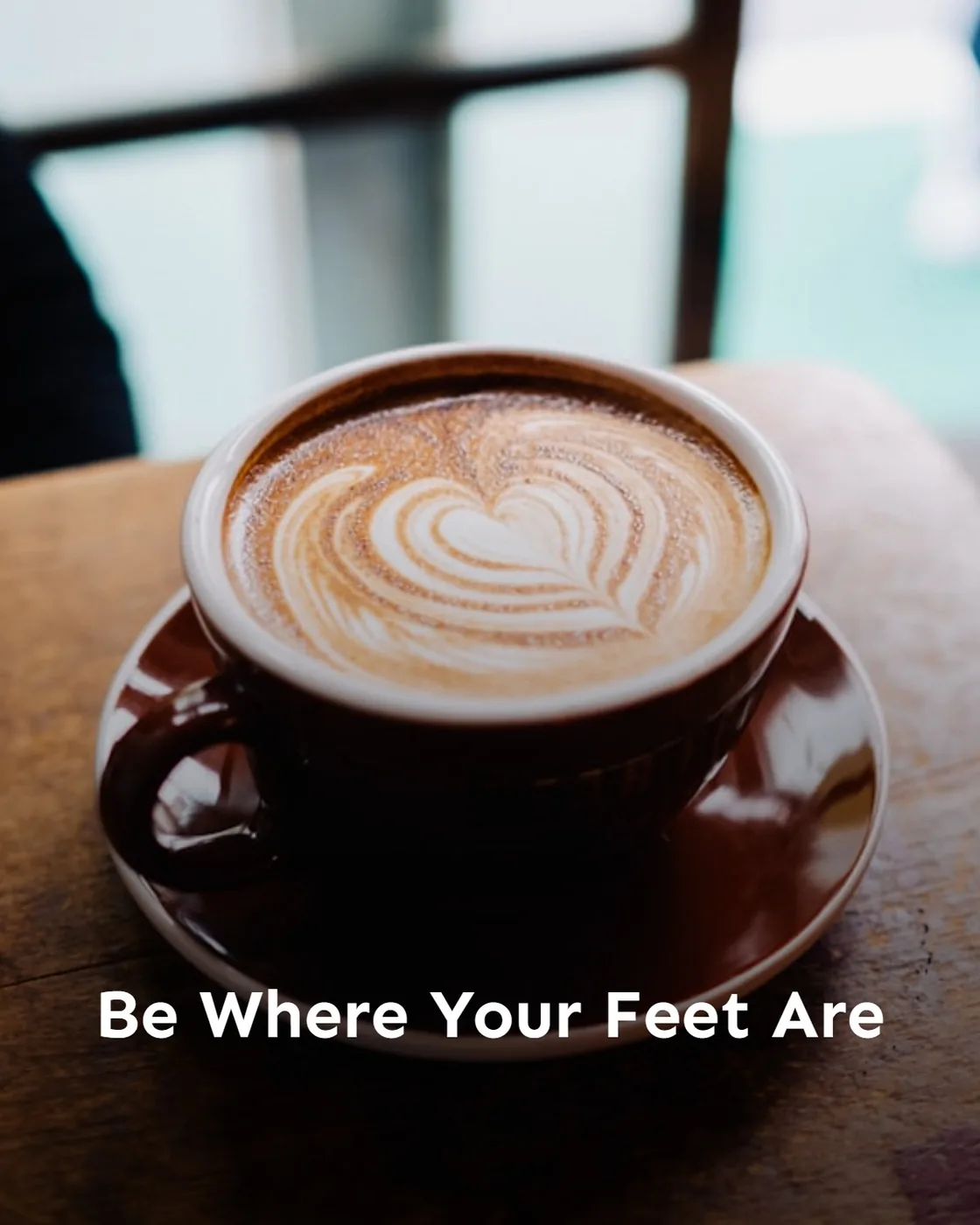
It was a cup. A proper cup. China. Saucer. The small cold lurch of a man realising, in the same instant, that he must have said for here, and that he was therefore not going anywhere for a while, and that the surrendered noise he had made at the counter had been heard, by her, as commitment.
A heart in the foam.
The lurch went the other way again, in the same half-second, into something quieter and warmer that he did not, just yet, have a name for.
He registered, then, that he was still standing at the counter, holding a cup and saucer in front of a woman who was now, politely, not looking at him, and that the next thing in the ordinary order of things was for him to take it somewhere. There were small tables by the window. He chose one. He walked to it with the careful steps of a man transporting something flammable, sat down, and put the cup in front of him, and looked at it.
He had done it. He had ordered a coffee in a place he had not known how to enter and he had got a coffee back and the world had not ended. He took, for a second, the small steady breath of a man who had survived a thing.
The bus flew past the window.
He watched it go. He watched, with it, the version of the morning where he made it to his desk on time, and watched the other version arrive instead, the one where he would shortly have to phone his boss and do the voice, the small breathless rushed voice, the apologies on top of apologies, all those tiny convincing background noises, the sense of a man already half running, somehow, into his phone. He would have to act. He would have to be good. A grown man, trying to convince another grown man over the phone that he was almost there, that the traffic was...that the bus was...that the something was... He took another small steady breath. He picked up the cup.
The runner had left with his stupid cruffin. The bell had gone again. The cafe was, for the moment, just the two of them, the woman at the counter and Fraser at the window with his heart in his foam, and she came out from behind the counter with the tea towel still in her hand, and she began, in an unhurried way, to busy her way towards his table.
Fraser, who had been doing fine, registered the distance closing in increments, each one a small step up in the level inside him. Four steps. Three. His eyes weren't sure where to go. She had stopped at a chair on the way to push it back in. Two. She was almost there. One. She stopped at his table.
Her nose moved in his periphery, very slightly. "Ah," she said. "It was you, then!"
Fraser blinked. "Eh?"
"When you came in. I thought I smelled something really nice! It's you. What is it?"
His brain, which had been mid-sentence in the small ongoing rehearsal with his boss, stopped, turned around, and walked back. He could see, in his head, the shape of a wee bottle on the shelf above his sink. The colour of the bottle. He could not, under any circumstance, have produced its name. He sprayed it on. He had been spraying it on for years. He had stopped consciously inspecting the bottle around 2017.
"Eh, I don't actually know," said Fraser, blankly, as his soul left his body.
She laughed. A nice laugh. Fraser felt the relief of it move through him before he had thought to be relieved, a warmth, a small involuntary chuckle.
"Honest answer," she said. "Whatever it is, it's nice. You should really find out!"
"Aye, eh, cheers," said Fraser.
She gave him a small nod, the kind that closes a moment without ending it, and went back behind the counter.
He picked up the cup. He sipped.
It was the best coffee he had ever had.
Christ, it was strong. Properly the inside of a kettle, no milk-in-the-world disguising this one. Dark and bitter and serious. He sipped again, in case he had imagined it. He had not. It was the strongest coffee he had ever drunk, and somehow, against every previous opinion he held on the matter, also the best, and the cup it was in was the best cup he had ever held, and the small heart in the foam was the best small heart in the foam he had ever been given, and the chair he was sitting on was the best chair, and the window was the best window, and the drizzle was the best drizzle, and the pavement outside, where he had stood three weeks running and not come in, was the best pavement on earth.
He looked, for half a second, towards the counter. She had her back to him, doing something with a milk jug. The slim shoulder. The loose strand at her cheek. Twenty-one mornings, he thought, of a shape in the glare. And there she was, six feet of pine table away, drying a cup like the most ordinary girl in the world.
He let his gaze settle on her, and his thinking drift, and somewhere in the drift he could see, dimly, the rest of his life laid out the way it had always been. The Costa. The medium cappuccino. The quiet man who didn't look up, who never would, who walked past things and called it living. He had been pretty good at being him. He could carry on being pretty good at being him. There was a version of him that finished this coffee, said cheers, slipped quietly back out into the drizzle, and never came in again.
She turned around.
She caught him properly, both eyes, mid-drift, and his face did the small hot thing of a man who has been found out. She paused, the cup half-down. Then she smiled, a small one, the kind that wasn't going anywhere. A second smile followed, smaller, the kind a person can't quite stop.
Fraser, who was being smiled at by a woman who had caught him staring, did what a man does in such a situation: he made a small theatrical fuss of his eye, blinked twice, frowned at the middle distance, performed, with the broadest possible mime, the mannerisms of a man with a contact lens out of position. He looked back at her. She had not bought it for a second. She was still smiling. He laughed, then, a short surprised laugh that surprised him as much as anyone, and she laughed too, briefly, and went on putting cups away.
He sat back, and turned the cup a quarter-turn on its saucer, and back. He was, he noticed, in no rush. He was almost never in no rush. The bus was long gone. His boss was completely unaware. The day was, by any sensible measure, a write-off, and he found, turning it over, that he didn't much mind, which was itself a new and faintly thrilling piece of information to learn about himself.
He finished the coffee. He set the cup down on its saucer, carefully, in the way of a man concluding something. He stood. He picked up his jacket. He went to the counter, and she came over, and there was the small ordinary business of the card machine, and he paid, and pocketed his phone, and that was it, the last moment, now or never, and without quite registering what was coming out of his mouth, he heard himself say:
"I'll probably know the name of it by tomorrow."
She looked up.
"The aftershave."
She held his eyes for a second, as if deciding something. Then with a smile: "I'll see you tomorrow, then!"
He stepped out into the drizzle, and the drizzle was the same drizzle, and the street was the same street, and the buses hurtled past and the gulls complained noisily and the whole grey industrial machinery of an ordinary Tuesday turned over exactly as it always had, and none of it knew. None of it had the faintest idea that the entire thing had just swung on its hinge. That a man had opened a door he had walked past for three weeks, and stepped through it, and come out the other side into a morning that looked identical and was not, would never be, the same morning again. He walked into it with his chest full of something he had no word for, a man who had stepped sideways off the rails of his own life and found, to his enormous surprise, more life underneath.
He made it two hundred yards before the coffee, strong and honest and serious, began its own industrial process, and Fraser, who could not now under any circumstances turn back, ducked into Costa.
Story complete!
Enjoyed this story? Sign up to like it, save it, and support the author.


Discussion