

Children of the Wastes
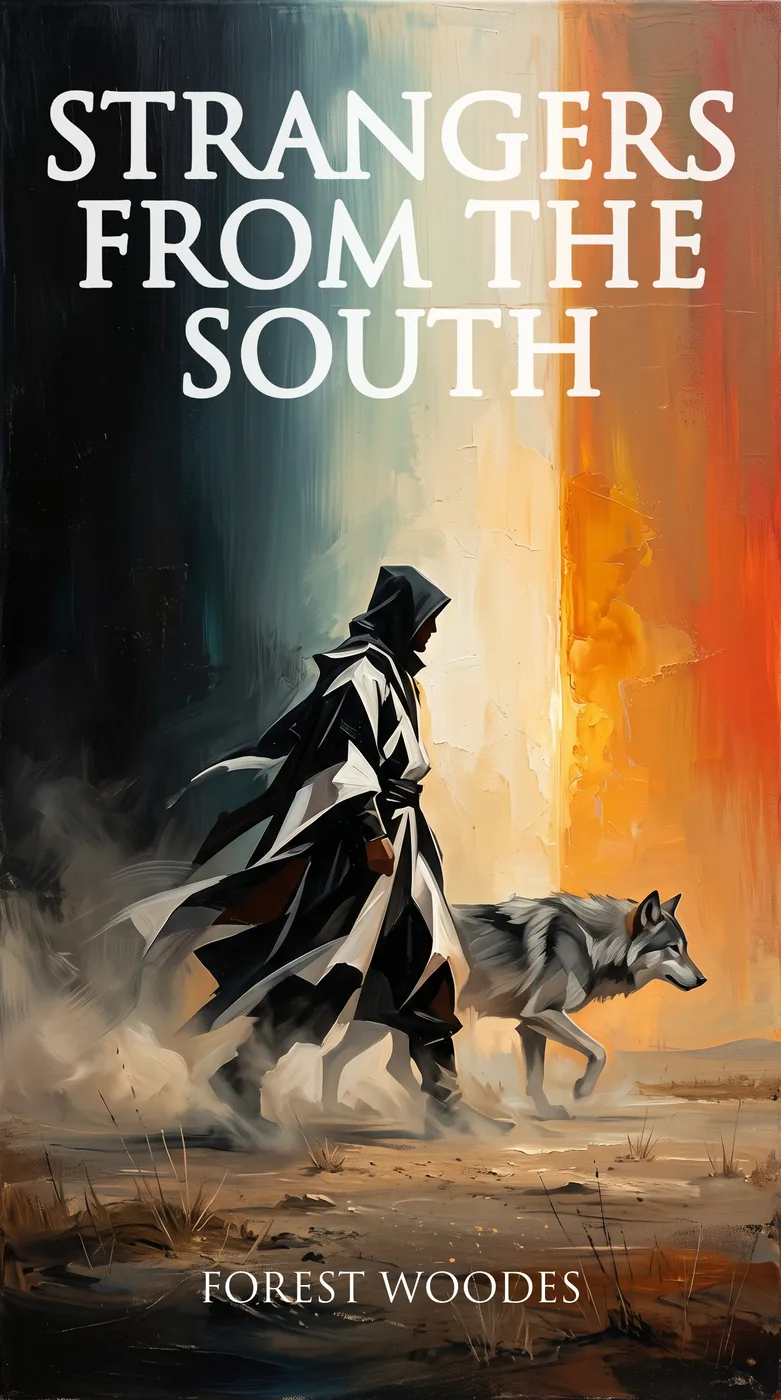
Listen to Children of the Wastes
Checking audio availability…
Ashwyn and Tamir walked west-southwest, hoping to take a ship across the Green Sea, bypassing the mountains, steppe, deserts and cedar forests along the shelf-like coast. They travelled across the vast deserts on the western-side of the rivers, passing through red sandstone cliffs, pebble sprawls and emptiness, with only the desert-wind to keep them company. It kicked up at nightfall, roaring around them, throwing up sand and rock, and more than once Ashwyn could swear he heard voices.
Red sandstone cliffs opened to galleries of cork-oak, cedar, and wild-olives over a dusty carpet of acacia thickets, hardy grasses, and stunted, bush-like tamarisk. The pair skirted the edges of the Land of Shrines, walking past the raised Tels and square-shaped temples of the dyer-settlements.
At the Green Sea coast, they walked south out of the plateaus and onto wind-scoured sabkhas—saltpans—that spread daily while the sea dwindled and the ice sheets in the north expanded south. No ships sailed west in the places they stopped, and the cities they found were dead or dying. The shrinking coastline left once-rich harbor towns stranded as the water receded.
They walked south, towards the Red and Black Lands, located north of the Lands of the First Men—the home of all beings who walk on two feet and think.
After several days hugging the coast, the land flattened and pebble fields, hardpan, and dunes shifted to a vast river delta with rich black soil that the donkey did not want to traverse, which only slowed them down. More than once, they yelled out on the shoreline, calling to passing fishermen to barter transport on pole-boats and rafts across the delta. The black soil stacked up in layers as the Great River of the South spread out in many muddy fingers before spilling into the Green Sea. Farming communities, called Turtle-shell Cities, spread across the delta, which was prone to seasonal flooding that the dark-skinned people living there revered and planned for. The islands in the middle of the muddy, branching flows were bordered by shorelines filled with lazy crocodiles, long-legged ibises, ducks, and graceful herons. Lilies, water-ferns, blue and white lotus flowers, and walls of reeds covered the surrounding waters. They meandered around the marshes of the delta, pushing away long, stalky papyrus standing up like walls. They followed natural levees through the marshy landscape, coming upon raised mounds with high-walled cities sitting on top, and everywhere they stopped, they were told, ‘There are no boats,’ so they continued on.
At a far-flung turtle-shell city, they stopped to rest. It was no more than a collection of huts, what could only generously be called a tavern, and the raised platform house of the chieftain. As they walked into the mud-brick walls, Ashwyn turned to look back and caught sight of dark-skinned locals, far out across the river, on papyrus boats and rafts, pole boats, and the occasional dugout. Around the mound was a papyrus palisade and crude-docks jutting out into the water.
The villagers with heads of tight-curls and black eyes watched them as they walked through the walls. Men in loin cloths, linen kilts tied around the waist and bare chests approached them first, gesturing to racks of fish—colorful tilapia and catfish, next to woven reed baskets filled with lotus seeds, water-fowl eggs, dried papyrus root and the occasional elephant ivory and obsidian tools.
Ashwyn asked the villagers who approached them first, “I am sorry, do you speak Tongue of the Plain? Alban? Old Tongue?”
But they stared at him and shrugged and then gestured to the bounty of the river.
Tamir shrugged and said, looking up at the elf, “I could eat.”
“What’s new?” Ashwyn said, laughing.
Ashwyn looked around the village of clustered oval and round huts made of stacked mud-brick and fieldstones, with upper portions made of acacia-braced wattle-and-daub. A few women and children eyed them. The children ran by the newcomers, wearing not a stitch of clothing, and the women whispered to each other, wearing simple, undyed flax and linen wraps.
Tamir said loudly in the Tongue of the Plain, “We don’t understand! Does anyone understand me? We need a boat! A big boat!”
“Helpful,” Ashwyn said, looking down.
“Watch it, dammit! I am trying.”
A dark-skinned man in desert clothing, much like Ashwyn’s, walked out of the oval, thatch-roofed tavern with a miswak—a chewing stick—between his teeth. He had flat features, skin that was as dark as basalt, a head of curly black hair, and wore a thobe, a turban, and an aba. A scar left by a blade crossed his face, but his black eyes were lively and relaxed.
He said in Alban, “Elf, dwarf, I can understand you.”
Ashwyn walked over, nodded and extended his arm, which the man took.
“Excellent,” Ashwyn said. “We are hoping to find a boat to travel across the Green Sea.”
“No such boat here, unless you want a raft,” he said with a smile, still chewing on the miswack.
“Dammit,” Ashwyn said.
“My name is Fula, come my friends. I can find you a boat, but I need something first. You both look more than capable.”
Fula turned, and Tamir said to Ashwyn silently while rolling his eyes, “Of course.”
They followed Fula into a darkened hut where he sat and offered them a place on the floor, passing over a bronze platter of roasted ibex-meat, lotus seeds, and papyrus root, to be washed down with mash-beer and mead.
The dark-skinned man ate a handful of lotus seeds and said while chewing, “I am a caravaner going west. I can get you passage on a ship when we end our route.”
“In exchange?” Tamir asked, slurping his mead.
“There are people out in the remote areas—Children of the Wastes, or sometimes called Kel Essuf—people who live in the deep desert with the Djinn and Burning Wind. They emerge from sandstorms—or sometimes they’ll appear from nowhere. They attack us and we need an escort.”
Ashwyn frowned, “Who are they? What do they look like?”
“They look like Sedu—like you, Albah, only with darker skin, golden or dark red eyes—they wear long indigo robes, but sometimes muted-colors—like the desert. Once, when I was a boy, I went west with my uncles. We went to sleep shortly after dusk. Something woke me in the night. I got up and looked and Kel Essuf stood all around me, encircling us. They didn’t make a single sound, not even the animals stirred. The Kel Essuf turned and vanished out in the night and nine of us were dead; not a single sound. They are desert elves, like you, but living in lonely, empty places. They’re surrounded by us—humans, pushed out into the wastes. That’s why they kill us.”
“They looked like Albah? Like me?”
Fula nodded. “Once, they were the only people out here. Now we’re here and they don’t like it.”
Tamir asked Ashwyn, “Did your people settle here? I thought you emerged in the south and then moved north, but didn’t go back.”
“If we settled here, I was not aware of it,” Ashwyn said, shaking his head.
“There are more,” the dark-skinned man said, “Southwest of here, there are Yumbos—they look like Albah, but are dark like me.” He said, pointing to Ashwyn.
“Strange,” Tamir said.
“Why strange, my friend? You hear of your people, too. There are the Elko south of here—dwarf-like people—like you. And Aziza, short people that taught humans how to make fire, how to hunt, how to make bronze and find the riches of the earth.”
Tamir nodded. “I had heard we still had people in the south, but I wasn’t sure. I thought it was just stories.”
Ashwyn shrugged, “The humans got it from somewhere. We didn’t teach them, they encountered your people first. Who else could it be? Obsessed with rocks, short, fondness for metallurgy. Maybe the Yakmen Reach expanded this far south?”
Fula said with a shrug, “The world is enormous, my friend. The landscape and time hide things—things vanish into the sands. People forget.”
Ashwyn shook his head, remembering something. “Do these Kel Essuf have a sacred tree like ours or the one in the east?”
The dark-skinned merchant nodded, “The baobab—the Tree of Life and Death. You only find those in the southern desert; it’s probably where they’re from.”
Ashwyn grabbed a few lotus seeds, popped them in his mouth and shrugged at the dwarf, who shrugged back.
Ashwyn asked Fula, “And you sure you can get us a boat?”
“Yes, Rus-Pinna has a deep water harbor, few left. That’s our destination. We travel out of the Black Lands, out into the desert, the Red Lands, then across the wastes until we reach Rus-Pinna. If we get caught in the winds, it may take us longer, but no more than four weeks. We may need to shelter somewhere.”
“Why?” Tamir asked.
“The desert wind; it can strip flesh from bone and there are sandstorms that last days. Block out everything, can’t see, can’t hear, totally lost.” He used a reed nearby to draw in the hard-packed earth, saying, “This is the coast and these—” he marked places with Xs.
Ashwyn finished the thought, “Water sources and shelter, no straight lines.”
Fula nodded, “No straight lines.”
Ashwyn shrugged at the dwarf.
Tamir shrugged back.
Ashwyn said, “Very well, we will be your security.”
“And then,” Fula said with a bright smile, “I will find you a boat.”
“Deal,” Tamir said and extended his arm. Fula took it and they nodded.
Ashwyn took Fula’s forearm and nodded. “Deal,” he said.
“Deal,” Fula said.
2
They set out in the morning, crossing the delta and emerging onto banks full of reeds, papyrus and shaded by closed rain-canopies and gallery forests of tamarisk, acacia, wild sycamore, fig and river willow, which grew in a band along the shore, bordered by sand dunes, hardpan, saltpans and pebble fields where nothing grew. The caravan’s animals were stabled in a nearby, square-walled caravanserai—a resting place with housing, warehouses, and stables.
Far on the horizon were the flat tops of plateaus and dry wadi canyons that fractured across the landscape. Blinding white limestone cliffs faded into red sandstone canyon lands.
The caravan laborers brought out the donkeys and camels first, and then emptied the flat bottom boats of sacks of copper ore, cedar pitch, raw tin, turquoise, and gold dust to be taken west and feed the dwindling cities around the Green Sea. Laborers piled the goods onto the pack animals, and then they set off, headed due west. Ashwyn led Rusty the donkey, carrying their own supplies and the growing bag of rocks Tamir kept adding to. Their caravan consisted mostly of Aamu, who were dark-skinned desert nomads traversing the wastes up and down the coasts and into the interior. They wore abas, long robes, sandals, and turbans which often covered their lower faces.
Tamir said, looking up at Ashwyn, “These clothes—okay, damn you, I’ll admit it: they’re more comfortable. I just feel naked without my armor.”
“The turban suits you,” Ashwyn said with a smile.
“Fuck you, elf.”
Ashwyn and Tamir were among several security escorts, led by a sergeant named Yuba, that seemed to know what he was doing. He sent scouts ahead on camels, set watch schedules, and maintained discipline.
They camped around an oasis the first evening—stripping the animals of their loads and leading them to the lily-covered water shaded by palms which dropped dates on the ground around them.
Fula, the caravan khabir—leader—who knew every stream, every lake, every oasis, every trail into the desert and typically navigated by the stars above, strictly adhered to their route.
Hunters riding on camels joined the main group at dusk, with two ibex slung over the camels' backs. The hunters dropped the animals, and the camp supply officers set to work skinning, butchering, and preparing them. Cooks prepared the ibex with crushed rock salt, mint found near the water of the oasis, wild thyme, rosemary, and wormwood, also called chih. As darkness descended, the cooks nearly finished cooking the meat over even fires.
Ashwyn had the first watch, and after eating, he set to work marking trails, landmarks, and watching the dunes and hardpan around the oasis. As the moon rose, a pride of lions silently stalked down out of the dunes, undoubtedly drawn by the smell of cooked meat. They sniffed the air, watched, and then walked quietly forward to the water. The lions drank at the opposite end of the oasis and then slipped back out into the desert.
Shortly after midnight, a guard tapped Ashwyn on the shoulder and asked, “Anything to report?”
Ashwyn turned, smiled and pointed, “Lions over those dunes, otherwise, it’s quiet. I am starving.”
“Get some food and sleep, I can take over.” The dark-skinned man in tattered robes said, smiling back.
“I stand relieved,” Ashwyn said, clapping the man’s shoulder and walking back to the camp.
Ashwyn approached the dying coals of the fire, sliced off a slab of ibex, chewed the savory, seasoned, charred meat, and then slept. He awoke to raised voices near dawn.
Fula was in the middle of yelling at Yuba, saying, “Where the hell is he, Yuba? It’s your job to keep us safe!”
Ashwyn rose, held up his hands and asked, “What happened?”
“Elam is missing,” Fula said.
Ashwyn shook his head. “I saw him last night. He relieved me. Did he not report in?”
“No,” Yuba said, crossing his arms.
Tamir was at Ashwyn’s side and said, “He was supposed to wake me for watch.”
“Shit,” Ashwyn said. “How long can we sit here?”
“A day, no more.” Fula said, and then held up his hands to Yuba, “I know what you’re going to say, he’s your brother-in-law, but we can’t wait.”
“I’ll go look. Maybe I can track him,” Ashwyn said.
Yuba nodded, saying, “Thank you,” and Fula said, “Go.”
Ashwyn shook off the grogginess and walked towards the dunes, with Tamir running behind him to catch up. They made their way to the water’s edge, to the spot he met Elam and found his own sandal prints and then Elam’s nearby.
Ashwyn said, “See the prints?”
Tamir nodded, “I got you.”
They followed the prints to the far side of the oasis, while Tamir called out tracks he found: “Lion, a few hours old,” and, “Wolf,” and “Looks like donkey tracks.”
They lost the tracks, circled back, and started again. The tracks walked up a dune and were joined by more. The tracks stopped and several circled it—bipedal tracks wearing sandals.
“I don’t like the look of this,” Ashwyn said, pointing.
“Looks like a party. You never heard them?” Tamir asked, looking up at the elf.
“I didn’t see or hear anything.”
Tamir tisked and shook his head. “To be this close.”
“I know.”
They followed the tracks, which soon merged into a single track, following the top of the dunes, and then the tracks vanished.
“Where the hell did they go!” Ashwyn yelled.
They circled back, followed the party, and then the tracks vanished, heading broadly out into the deep desert. Ashwyn studied the marks, considering that the party swept the tracks behind them, but there were no marks left by a frond.
Ashwyn and Tamir walked back to the caravan, reported in, and the oasis became a hive of activity as laborers loaded down the camels and donkeys, and soon they were off again.
Ashwyn sidled up to Yuba and said, “I am sorry about Elam. I really looked everywhere.”
“I know,” he said. “My sister will not take this well.”
It was about midday when they emerged onto sparkling, pinkish-white saltpans that crunched underfoot. Far off, in the middle of the flat, sparkling surface, was a stake and something tied to the stake.
As they came closer, they clearly saw a person tied to the stake. Elam's captors stripped him naked. Honey coated his skin, and ants crawled over him. He raised his head and empty sockets met them. His eardrums were pricked, and his ears bled.
Yuba ran out of formation, cut Elam’s bonds, and laid him down, while Ashwyn, Tamir, and Fula walked out to formation to examine the man.
Tamir turned away on seeing Elam. Ashwyn’s stomach turned, and Fula said to them both, “This is why you were hired. To fight this.”
Tamir asked Fula, “Why deafen and blind him?”
“To prevent him from telling anyone who did this to him,” Ashwyn said and pointed, adding, “They cut out his tongue as well.”
Fula looked at Yuba and said, “Well, do it. We can’t wait here all day. All of us die if we wait out here.”
Yuba looked at Fula with a grimace, and Fula rolled his eyes, strode forward, pulled a bronze dagger from his belt, and slit Elam’s throat.
He pointed the bloody dagger at Yuba, “You know the rules, Yuba.”
“We could have saved him!” Yuba pleaded, while Elam bled out and slumped to the ground, cradled in the arms of the big man.
“Saved him? It was mercy and you know it.” Fula yelled out, “Let’s go! Get your asses moving! We have to find water by nightfall!” And walked off to the caravan.
Tamir let out a long breath, and Ashwyn grabbed Yuba’s shoulder and said, “I am not sure I could do it either.”
“We need to bury him!” Yuba called out, dropping the corpse and standing.
Fula walked back over and said in a tense, quiet tone, “We keep moving or we die of dehydration. If you want to bury him, then do it, but we’re not going to stop.”
Ashwyn said to Yuba, “C’mon, we need to move. You can bury him on the way back. He’s not more than half a day from the oasis.”
Yuba considered his brother-in-law being consumed slowly by the ants with his hands on his hips. His shoulders slumped and shook his head, and then he turned and walked back to the caravan and carried on.
Tamir slapped Yuba on the back and said, “Hard fucking world, Yuba. Too damn hard.”
Yuba turned, nodded with tears spilling down his cheeks, and all three rejoined the group and carried on west.
3
They walked on, first coming to a red-and-white canyon land capped with a flat-top plateau and a small stream surrounded by eroded rock, sand, and thin soil forming a cut at the bottom—evidence of brief, but violent seasonal flooding. Hardy grasses, herbs, and a handful of palms covered the banks.
While they rested the animals, Ashwyn looked around. He found a shelf of crumbling limestone and entered a cave. Depictions of wild animals—rhinos, aurochs, and crocodiles, along with stick figures holding bows or hunting, covering the walls in deep etchings greeted him. Below them, or sometimes drawn over the etchings, were large-eyed figures with pointed ears, masked ritual scenes, spirals, hashtags, and doodles elsewhere in ochre or charcoal.
As Ashwyn considered the art, Tamir walked into the cave and joined him at a wall. He asked, “Where are all these animals now?”
Ashwyn looked over at the dwarf and then back to the wall, and said with a sigh, “The ice at the top of the world grows and as it does, the seas dwindle and the desert spreads. This entire desert was once green. I wonder who created all this?”
Outside, the sun dipped behind the canyon lands, cooling the still air, and Fula called out, “Ashwyn, Tamir, we walk!”
They walked out, meeting the caravan along the bank where animals slurped and dark-skinned men rested under the shade of meager trees, or reclined in the grass, sleeping off the hottest part of the day in shade and near water.
“Beautiful country,” Tamir said, walking over.
“In a bleak sort of way,” Ashwyn said, nodding.
“Why are you always so damn gloomy?” The dwarf said, smirking.
Ashwyn laughed.
They waited until evening, and then the caravan continued out of the canyon lands, climbing up onto a plateau made of hardpan and blowing dust. Hours later, as the sun dipped below the horizon, the sky turned orange around them and dust kicked up, forcing them to cover their faces.
Across the horizon, a fuzzy, rolling wave inched towards them. Thunder echoed into the distance, and just visible in the evening light were forks of lightning across the spreading, rolling clouds that spanned the horizon.
Ashwyn dropped back, walking in line with Fula and yelled over the roaring wind, “Sandstorm; we need to find shelter!”
He shook his head. “There is no shelter my friend, not for a few hours. When we come down off the plateau we will have shelter.”
Fula called out to Yuba, on the other side of the caravan, “We need to spread out around them!”
Yuba nodded and shouted orders to the mercenaries in the band, “Around the caravan! Form a parameter!”
Ashwyn asked Fula, “You don’t think they’ll attack during a storm, do you?”
“Yes,” he said.
Soon, the rolling wave of sand formed winds that carried everything towards the incoming wave. An Aamu tribesman walked amongst them, handing out bone-slit protective eyewear which was fastened using cured leather. Ashwyn donned his, and the world narrowed to horizontal slits. They donned their hoods, wrapped the loose abas around them, and waited. The laborers unrolled a long rope and clumped into a ball, tying the rope around their wrists, while the scouts and mercenaries formed an outer wall.
The wind howled around them, picking up speed as the sandstorm sucked all the atmosphere, the rocks, the sand and dust towards the rolling, towering wave on the horizon. Resonating thunder followed the lightning, which forked across the sky.
And then it came on them all at once in a howling, stinging wind that darkened the dim evening light to nothing. Ashwyn raised his arm instinctively and buried his head in his chest. Even fully covered, the wind was enough to reach him and knock him off his feet.
A man at the top of the column started singing to guide them forward. He had a strong, deep voice that just barely floated above the wind. This was joined by shrieking bone whistles and terracotta lanterns—clay pots with tiny holes that barely gave off any light, but were enough to keep the group together. Ashwyn watched the lights. One went out ahead of him, and a scream followed it.
Ashwyn yelled out, “To arms!”
The singing voice silenced with a yelp.
“Shit,” he said.
The man in front of him, barely visible, seemed to vanish in front of him, and Ashwyn looked down through the slits to see a blood puddle where the man once was. All at once the animals bawled and whined, and another lantern disappeared. And then another with a bloodcurdling scream.
Ashwyn ran forward to guide the caravan. He could barely make out his own arm in the storm, but the lights still flickered out in the darkness and roaring wind. He pulled out a bone whistle and continued on, and heard still more shrieks around him.
He looked back and did not see lanterns or even the vague outlines of the caravan; instead; he was surrounded by people in loose, tied robes and covered faces, all with dirks, swords, and bows at the ready.
“Dammit,” he said, raising his hands to his head.
One of the ghostly figures approached and bound his wrists; his sword—a token and heirloom from his love—was removed from his back, and he was pushed forward, away from the caravan and out into the storm.
4
Robed figures pushed Ashwyn out into the desert, urging him forward. The robed figures took him to a canyon where the wind died and tied him to a stake in a dripping cave. He was bone-tired and soon he fell asleep despite it all.
He woke to raised voices. Upon opening his eyes, he scooted back, wide-eyed. It appeared as though a lion were face-to-face with him, but when he looked closer, he saw it was someone wearing a lion’s head as a mantle and hood. The man with dark skin, golden eyes, and pointed ears wore a linen skirt, fringed by red tassels at the bottom and bound at the top by a wide leather belt held in place by bronze buckles. His body bore tattoos, which people in the West called peig-gho, or painted spirit. Humans and dwarves adorned their bodies with totem animals, but this man covered his body in spirals, geometric shapes, and hash lines. Wrapping his arms and legs were bronze and corded bands with red tassels and shiny bronze bells that tinkled when he moved.
Ashwyn cleared his throat and asked the man just inches from his face, “Can I help you with anything?”
Ashwyn looked around him and saw he was in a cave complex, and just outside the door were limestone dwellings, carved directly into the rock, with dark-skinned people walking by.
The man wearing shiny bronze, seashells, ostrich eggshell, animal teeth, carnelian, amber beads, and a pouch around his neck asked, “Albah?”
Ashwyn nodded, “Albah.”
“Hmm,” the man said.
Ashwyn noticed the holy man’s walking stick and nodded with his chin, “Ash? You carry ash?” And then thought of the closest language—the Tongue of the Plain—hoping it would translate, saying, “Manu?”
The holy man nodded, “Manu, Yemo, Trito,” and made a triangle by joining his fingers.
Ashwyn shook his head, just noticing the headache roaring inside his head and realizing how dry his mouth felt, and said, “No, not that. Ash tree. Forget it. Do you have any water?”
The holy man laid a palm on Ashwyn’s chest and said, “Priest.”
The shaman did not use the Alban for priest—Wyd—or Knowing One, but an older variant ‘Widu.’
“Why does everyone keep saying that?” he asked, more to himself than to the shaman, adding, “No priest. No, no—what’s the word...” Ashwyn thought and used a word from further south for the archetype that was spread across the planet, “Ogo, um, what were their names...” he trailed off and saw the shaman watching him keenly and then blurted out, “Ogo, Ndo, Ana? No Ogo,” and shook his head.
The shaman nodded, said, “Ago, Ndo, Amã,” and stood up and yelled out.
A boy walked in with a copper pot and ladle. They did not remove his bonds, but the boy with dark red eyes knelt, bringing the ladle to his lips so he could drink.
Ashwyn knew the story well. Everywhere he travelled in the world, he came across the divine twins and the third. Sun, moon, twilight. Light, darkness, color. The Creator, the Destroyer, the Preserver. The Living, the Dead, and the Creator—One who died and lived again. In the west, the story was brought from the steppe and still carried by the humans there, spread by elves and humans both, extending from one ocean to another. Two brothers—two poles and a third which acted as the fluid boundary between them. The First Priest sacrificed his twin, who was the First King. The Thirdborn took the broken body and created the world. Ashwyn was not a priest, nor did he want to become one, and his twin brother Yuvan was dead, a long, long time dead, but everywhere he went people called him ‘Priest.’ He didn’t even like the gods and thought of them as a pain in the ass. The shaman and the boy left him.
He remained alone in the limestone cave and observed the shadows spreading across the canyon. Towards nightfall, curses, yelling, and a familiar voice echoed across the canyon.
He heard a tribesman say excitedly, “Dng! Dng!” And a group of people just outside the cave entrance dropped their chores and ran by, while someone outside yelled, “Get your hands off me! Off me, damn you! When these bonds are cut, you just wait!”
They pushed Tamir into the room and secured him around a post holding up the cracked limestone above.
Ashwyn laughed a little and said, “Fancy meeting you here.”
“You’d think they never saw a Yakmen before! The whole damn city came out to see me.”
“Fair chance they haven't seen your kind. They have a word, at least, so some memory exists.”
“Is that what that was?” Tamir asked, struggling against his bonds.
“Dng—it’s from further west. There it’s ‘Deneg.’” Ashwyn said, nodding.
Tamir’s smile dropped to a frown. “Why aren’t we dead? Also, I am pretty sure the entire caravan is gone and so are all our belongings,” he added sadly, “And my rocks.”
“Maybe some survived. I drank a few hours back, but otherwise, they’re ignoring me.”
Tamir said with a shrug, “Better than being tied to a stake and covered in honey, I suppose.” He gestured outside with his head and asked, “Those are Albah out there, aren’t they?”
“They are. They did not spare Strangers? Just us?”
“I have seen no humans. Just us.”
The entire settlement gathered outside the cave-mouth, whispering to each other and staring at the dwarf and elf.
“What the fuck is this?” Tamir asked.
“No idea.”
The shaman walked back in with the boy, who held a copper pot and a wooden spoon. He nodded at the boy who approached, dipped the spoon in the pot and held it out to Ashwyn. It was not water; Ashwyn smelled honey, blue lotus, and kif—southern cannabis. He looked at the shaman who studied him and then the boy, with dark skin, dark red eyes and a sinewy look Ashwyn associated with humans, and then sipped. The concoction was enough to ease him into a second part. The shaman dismissed the boy, and then the shaman walked out and came back with smoldering acacia branches and held them under Ashwyn’s nose. He waved them in front of Ashwyn’s face, making sure he inhaled and his perception shifted sideways.
Ashwyn left his body first with a roar of sound, travelling through a tunnel of starlight. He stood on a wheel that spun round and round, and the world around him emptied. There were no more fields; instead, horses that had turned wild over long years trampled the meadow where softly bending pale-golden wheat once sprouted. His home would be ground under ice sheets spreading south, obliterating his people forever. No prophecy, heroes, or dark lord existed—only an indifferent world that moved on incomprehensible timescales, and nothing could stop it. The tug of war the climate had fallen into between hot and cold would end when the deserts spread, the seas dwindled, and the ice sheets advanced south, freeze-drying the surrounding land under howling winds, reducing the forests of his homeland to lowland pockets, waiting in refugia to be reborn one day when the time was right because the wheel turned. Einkorn, apples, goats, horses would turn feral again only to be tamed once more fifteen thousand years after the ice spread, still carrying the ancestral memory of the Albah domestication. Everything he saw around him turned on the wheel. Nature would reclaim the world once more, and the Strangers from the South would remain, hunting the last mammoth to ever live and spreading relentlessly outward. Their cities would one day cover the earth, and they would fill the universe itself with a chorus of voices where once there was vast, empty silence. The sacred trees at opposite ends of the world would die, and with their passing, so too the elves, dryads, dwarves, and magic. They were all dying, and he felt the weight of his long years. Even the gods would disappear behind the veil. He saw the silhouette of a man obscured by shadow as dark as death rushing up to meet him, and something formless coalesced between them, growing stronger the closer they came to each other, and there in that energetic void between them was a white lotus flower and a black lotus flower coiled around one another. The wheel turned, bringing him to an end and back to the beginning. In its passing, day slid into sunset, and throughout the course of the turn, a starry night spread like a burial cloth across the sky, which soon met the unsympathetic and beautiful dawn. The Evening Star was the last to fade above when the sun crested over the eastern horizon.
He blinked and met the eyes of the Knowing One. He looked over and caught the concerned eyes of Tamir. And then, the vision faded, as if nothing had happened, and he could not recall a single feature if his life depended on it. It was gone.
He asked Tamir, “What happened?”
Tamir said with a grimace, “You started babbling about the humans, wheels, twins. How everyone was going to die. It made no sense.”
The shaman stood up, let out a long breath, and said, “Priest,” and left them, walking out into the night. He said to the villagers, still gaping at them from the cave mouth, “Widu.”
And the entire village burst into tears; they wailed, tore their clothes, shouted lamentations and curses to the sky, and threw ash and dust on their heads. The time of the elves was over. They knew it. He didn’t.
5
An argument ensued as the villagers mourned and a tall, long-limbed man soon followed the shaman back into the cave. The priest pointed at Ashwyn and spoke heatedly with the newcomer. The pair argued back and forth and Ashwyn did his best to clear his head of cannabis, acacia smoke, and blue lotus.
The new man wore an aurochs mantle and hood of horns from an aurochs with raven feathers tied to the horns. He had only one eye, the other covered by cured leather tied tight across his skull. If Ashwyn looked closely, he could see stars in his pale, open eye, but then he turned his head and the effect vanished, and Ashwyn wasn’t sure whether it was the cannabis and acacia, or reality. Around the newcomer’s neck was a red mark of paint. Across his dark–skin were white dots, as if his entire body were the Night Sky.
Tamir asked from behind the man studying Ashwyn, “Who is he?”
“I am not sure. He isn’t dressed like the Knowing One.”
The man with long limbs stopped his argument with shaman and said, “Bal-il,” and pointed to his chest.
He knelt and studied Ashwyn, and then he said while cutting his bonds, “You live, you priest. You die, no priest. Come.”
The shaman called out, and the same boy as before walked in, handed Ashwyn the heirloom sword given to him by the only woman he’d ever loved, and then left.
Ashwyn walked out into the moonlight, pushed forward by Bal-il behind him, and when the city residents saw him, they fell into silence. The shaman guided him to a ring of stones past the settlement dug into the white cliff-side, and across the stream running at the bottom.
Ashwyn pulled the blade from the scabbard off his back, looking at the dark, fluid blade called Starfall—the Yakmen steel made from the iron of a shooting star, with glowing runes down the blade in a language so ancient, no one could decipher them and then he waited.
The shaman pushed through the front of the crowd and watched him. Ashwyn walked over and asked the man in the lion mantle, “What is this? Why do this? I am not a priest, dammit!”
But the shaman said nothing in return. No one said anything. The entire city crowded around Ashwyn, saying nothing. Only the wind could be heard. It picked up in gusts, blew through the canyon, and spawned spiraling dust devils that subsided with the gusts.
Bal-il entered the ring. It was then Ashwyn considered the name as the man stripped out of his regalia, down to a loincloth, holding a long, straight cross-hilted blade that shone in the moonlight and a koummya—a short, curved dagger in his other hand. Bal, he thought, meant Lord, and Il meant the sky. “No,” he said to himself, watching the man across the stone ring, “El is day sky, Il is night sky.”
Is he the Night Sky? Ashwyn thought. I am meant to fight a god?
Ashwyn asked Bal-il, “Are you the Hanged One? The Wanderer?”
And Bal-il said nothing.
“Are you the Night Sky?” Ashwyn asked. He yelled out, “Are you possessed? Can he see me? Can the other? The one with stormy gra—” and then he trailed off as a girl walked through the crowd and stared at him from across the ring. She had gray, piercing eyes and stood still while those around her gave her a wide berth, standing several feet away. Overhead, an owl circled in the moonlight.
Ashwyn stretched, readying himself, and then he stood at his edge of the stone circle and waited. Bal-il stepped out into the moonlight across from him. They circled one another.
Bal-il approached, swept low and spun with the motion, kicking up dust and stopped with his back to Ashwyn, who briefly thought, ‘What an idiot,’ until he saw the sword blade move backwards. Ashwyn parried and then kicked Bal-il, who tumbled away.
“Who are you? You’re not the Wanderer! You’re no god!” Ashwyn yelled out.
Bal-il answered with both blades, first swinging high to raise Ashwyn’s arms and then spinning inward, using the knife to thrust with his backhand. Ashwyn turned his shoulder, pushed, and then used his foot to trip the man as he moved closer. Ashwyn kicked Bal-il, pushing him back again.
When he recovered, Bal-il moved forward in a springing motion so fast, Ashwyn could not follow him, and then kicked the dust, aiming right at Ashwyn’s eyes, blinding him. A dribble of something warm poured down his cheek, and Ashwyn backed until his heels met the fieldstone barrier. He reached up and drew blood from his cheek.
Ashwyn burned with rage that he kept on a leash. His hands shook, adrenaline coursed through him, and he gritted his teeth. Ashwyn walked forward with a snarl and brought the blade down in an arc and then back up in another arc, over and over, hammering the man backward with figure-8 swings of the blade—up and then down in an arc; down and then up in an arc, beating the man backwards, screaming loud enough that a ringing hung in his ears. On a downswing, he moved in, brought a hand off the hilt, grabbed Bal-il’s hand with the dagger and twisted until it dropped to the dust. He kicked the legs out from under Bal-il, held his arm and pushed down with the blade towards his throat.
Ashwyn screamed, “I’ll fucking kill you! Do you hear me!” he screamed to the heavens, “Let the Night Sky see me! Your vessel will die! Death awaits you all!”
Bal-il pushed on Ashwyn's sword hand, while Ashwyn pushed down, overcoming his strength, bringing it closer and closer, and screamed, “You’re all going to die!” Though he could not say why it fell out of his mouth in a roar.
Bal-il kicked him in the groin, in the legs, in the stomach, but Ashwyn moved the blade closer and closer to the man’s throat. Ashwyn could ordinarily control himself. Many sought to purge their rage, but Ashwyn put his on a leash, and it was then he let go of the leash and brought the blade across the man’s throat, spilling his blood into the dust and rose. He shook all over and pointed the bloody blade at the crowd, screaming, “Who’s next! Is it you! You! Who wants to die!”
The crowd watched him but said nothing. Their eyes all turned to the strange, gray-eyed girl who stepped into the ring, out into the moonlight. She walked over to Bal-il, dipped her thumb in the blood of the dying, gargling man and walked to the shaman. She placed her thumb on his forehead, smearing the mark, and then she walked back into the ring, while the desert elves tore their clothes, threw ash on their heads, and cried to the unsympathetic night sky above. Wailing, mourning cries and lamentations echoed across the canyon.
They were all dead, Ashwyn thought. He was dead, Tamir was dead, the elves, the dwarves, the sacred trees were all dead, and it was the Strangers from the South—the humans, who would remain, but he was not sure where this knowing emerged.
The gray-eyed girl turned, walked over to Ashwyn, staring up at him under the stars, and Ashwyn’s heaving relaxed, and he took deep breaths. He kept his sword up, but with a gentle hand, she pushed it down. He flicked the sword, drawing off the blood and sheathed it, though he could not say why. The girl grabbed his hand and led him out of the ring, and he noticed then that she was crying. She pressed her body to his, and he took a shuddering breath and put his arm around her and shook as his adrenaline crashed.
“It will be okay,” she said softly. “It’s done.”
She wiped a tear away, wordlessly laid her head over against him and escorted him back to the cave, tied him back up and before Tamir could ask what happened, the boy entered wearing a wet cloth over his nose. He waved smoking henbane through the cave and left. They both became instantly drowsy and fell into a dreamless sleep.
It was fully dark when they woke, with their bonds severed. The village outside was empty and silent, bathed in silvery moonlight. Winds stirred the empty canyon, blowing down through the rock wall, stirring whirlwinds that subsided with the wind.
They rose and walked outside, where their goods sat in a pile outside the door. They wordlessly re-equipped themselves and then walked north and west.
“What was that about? Also, I am getting sick of saying that!” Tamir said, looking back at the empty village.
“I don’t know. I—I don’t know.”
“What were you yelling about? Who is going to die?”
It was as if he was in a stupor—a fog, something. He sighed and said, “I don’t know. Let’s go.”
An hour before dawn, they passed the caravan. Everything was dead; the animals, the people—everything. Ashwyn and Tamir dug around the remains, some already in the process of being buried and desiccated.
“Should we bury them?” Tamir asked.
“No, we should walk on. If we’re caught out here without shelter or water, we’ll die. We head north and west.”
Tamir nodded, and they walked on.
Ashwyn dug around in his satchel, dangling on a hip, pulled out his pipe, packed it with kif and used a stone and iron-pyrite fire-starter to light it with shaking hands.
“Fuck,” he said, dragging on the pipe.
An unsympathetic but beautiful red dawn lit the eastern horizon behind them, while the west and the north remained in darkness.
Story complete!
Enjoyed this story? Sign up to like it, save it, and support the author.
Discussion