

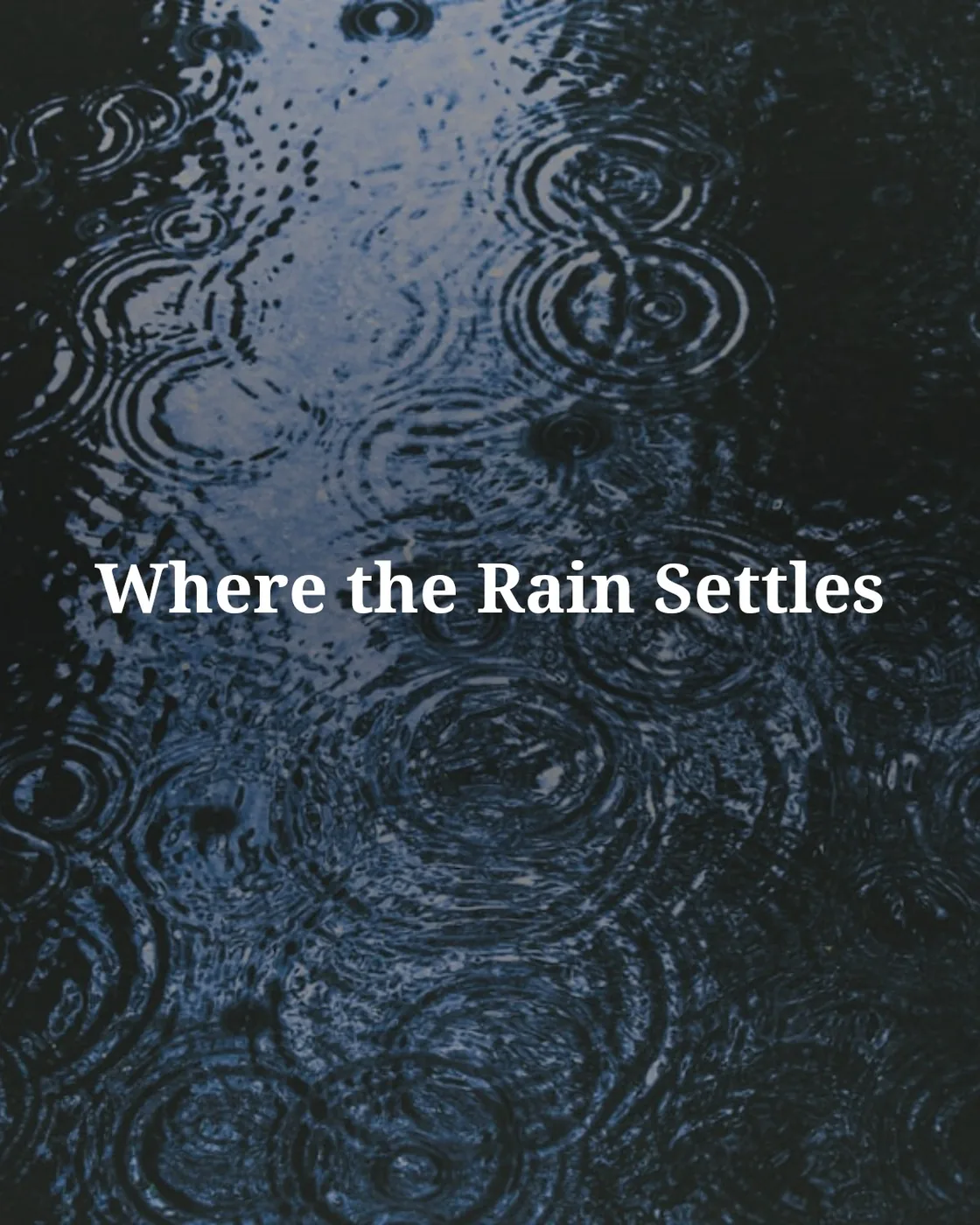
Where the Rain Settles
Listen to Where the Rain Settles
Checking audio availability…
Where the Rain Settles
The rain had not stopped for sixty days. It had turned Ratanpur into a bog. Inside the houses, the walls wept moisture, and the grain in the sacks had liquefied into a grey, rotting paste. Raghav sat at his kitchen table, staring at a rusted iron latch—the only thing keeping his door shut against the humidity. He didn't just watch the village die; he tracked it. Every day, he recorded the rainfall and the water levels in his notebook. The village well, an ancient stone structure in the square, was the centerpiece of his dread. It was a relic of a time before recorded history, built from obsidian-dark stone, its surface etched with occult geometry that defied natural patterns. The elders whispered that it was not built to hold water, but to keep things down. Raghav remembered the archives in the village library. He spent hours there, his flashlight flickering against the damp, decaying paper. He wasn't just looking for history; he was looking for a pattern. He found old, hand-drawn maps of the village where the well was marked as the 'Heart of the Earth.' In the margins of a 1914 diary, someone had scrawled: 'It does not drink the water; it drinks the memory of those who fear it.' For the first time, the elders' forgetfulness stopped looking like age. It looked deliberate. They forgot because if they remembered, the bargain would break, and the well would demand payment in full. The mold here was thick, breathing like a silent velvet skin over the collapsed shelves. Every book he touched turned to a wet, pulpy mash between his fingers, smelling of ancient riverbeds and forgotten decay. The dampness didn't just cling to the paper; it felt like it was actively erasing the ink, trying to wash away the sins of the village before he could read them. He recalled reading about the "Great Drought of 1842," where the village had nearly vanished, and how, overnight, the wells had flooded with ink-black water. The village didn't survive by God’s grace, but by a bargain. A bargain written in hair and bone. Back then, he thought it was just a dark bedtime story to keep children from wandering too close. Now, the symbols on the stone didn't look like mere carvings; they looked like scars. They were the stitches of a wound that was never meant to heal. Raghav stood up. He grabbed a lantern and a heavy crowbar. He had to know why the village elders had barred the well decades ago. He stepped outside, his boots sinking into the ankle-deep muck. The square was empty, but as he reached the well, he saw the priest, Haren, standing there. Haren wasn't praying. He was pulling a heavy iron chain. Raghav hid behind a collapsed granary. He watched as the well’s cover—a massive stone slab—was dragged aside. The smell hit him instantly: raw sewage and old, wet hair. Raghav moved closer, his heart hammering against his ribs. He saw Haren lift a bucket. It wasn't water that came up. It was a thick, viscous sludge filled with long, black strands. Haren didn't flinch; he began to chant, his voice flat, rhythmic. Raghav crawled back into the shadows, his breath hitching. He had to know the truth. If his grandfather hadn’t just "vanished" in 1994, then what remained of him? He crept toward the priest’s small, shack-like dwelling behind the well. The door was unlocked. Inside, the room was a shrine to decay. Shelves were lined with jars, each filled with cloudy, yellowed fluid. He shone his lantern on the first jar. Inside, preserved in a way that defied nature, was a human finger, its nail etched with the same occult symbols he had seen on the well’s rim. He pushed aside a heavy, moth-eaten curtain. The room beyond wasn't just a shrine; it was a workshop of biological horror. On a workbench, he found a bowl of wet clay being molded around strands of human hair, shaping what looked like miniature effigies of the villagers. He picked one up—it was still warm to the touch. It had his own face, crudely carved, but unmistakably his. The clay wasn't ordinary river mud; it was black, heavy, and laced with tiny, mineralized flakes of prehistoric bone that glittered under his lantern light. It pulsed with a faint, sickening warmth, as if the soil itself possessed a nervous system. The hair woven into the effigy’s skull felt identical to his own—coarse, damp, and rooted deep into the rotting earth. The realization hit him like a physical blow: he wasn't just a future offering; he was already being prepared. Every breath he took in this village was being measured and harvested by the thing in the well. He opened a ledger lying on the table. It was a census, but not of the living. It was a list of every villager who had "left" Ratanpur over the last two centuries. 1842: Elias
Thorne (Harvested)
1914: Clara Vance (Deepened)
1994: Arjun Sharma (Raghav’s grandfather - Anchored) Raghav’s blood turned to ice. His grandfather hadn’t been an offering; he had been anchored. He flipped the page, his hands trembling. There was his own name, written in fresh, wet ink: 2026: Raghav Sharma (Initiated). He heard a low, rhythmic thumping outside—the sound of the villagers moving in unison. They were no longer walking; they were shuffling, their feet dragging in the mud. The thumping sound grew louder, vibrating through the soles of his boots. He watched from the darkness as the villagers emerged from the mist. They moved as if the well had taught every body the same rhythm. He held his breath, praying they wouldn't look his way, but as Haren turned, the priest’s eyes didn't focus on him—they focused on the sound of Raghav's frantic heartbeat. He scrambled to find a weapon. He grabbed a bottle of kerosene from the corner and a stack of old, dry records. If he couldn't stop the well, he would destroy its history. He ran back to the square, but the villagers were already standing in his path. They weren't aggressive; they were waiting. Haren stepped forward, his eyes milky and vacant. "You aren't just an anchor, Raghav," Haren whispered, his voice sounding like two stones grinding together. "You are the bridge. The well needs a voice to call the next generation. Your grandfather’s voice has grown faint... but yours? Yours is still young. Still full of fear. That is the best kind of fuel."Raghav stepped out of the shadows. "Stop!" he shouted, his voice cracking. He raised the crowbar. "That’s not water. You’re poisoning the soil!"Haren didn't look surprised. He looked weary. "The village survives, Raghav. We don't starve. That is the bargain. The well takes, and the earth gives back." "My grandfather was murdered," Raghav said, his grip tightening."He was an offering," Haren replied. Raghav lunged. He didn't want to debate; he wanted to smash the well’s rim. He swung the crowbar, but his feet slipped on the slick mud. He fell hard, the crowbar clattering into the well. It didn't hit the bottom with a clink of stone; it hit something soft, something that hissed. Raghav's eyes widened in sheer horror. Before he could even reach the well, the entire village was already there, barefoot, standing in a silent circle. Their lower limbs were slowly sinking, merging into the muddy earth as if the soil was reclaiming them. The black water had completely receded into the dark depths, but the ancient wooden pillar had now surfaced in its entirety. Its surface was not tree bark; it was woven from the rotting flesh and calcified bones of those sacrificed centuries ago. The villagers kept their mouths wide open, staring into the abyss as long, wet strands of human hair oozed out with the sludge. Raghav raised his crowbar to destroy the structure, but his arms froze in mid-air. He heard the sickening snap of his own bones dissolving. Everything became blindingly clear—the water had receded, but the ancient terror beneath the soil had risen to claim them all. Raghav dropped the weapon and began to sink into the mound of flesh and wet mud, forever."You drank the rain, Raghav," Haren said, standing over him. "You’ve breathed this air for two months. You are already part of us." Raghav felt a tickle in his throat. He coughed, and a long, wet strand of black hair fell from his mouth onto the mud. He tried to stand, but his legs wouldn't obey. His bones felt loose, like they were dissolving. He looked at his hands; the skin was translucent, showing dark, branching veins that pulsed in rhythm with the well. He didn't scream. He looked at the well one last time. He saw the crowbar resting on a mound of rotting human sinew, buried under a layer of wet hair. The villagers didn't touch him. They simply waited. Raghav sank into the mud. His body felt heavy, turning into the same sludge he had seen in the bucket. As his face pressed into the cold, wet earth, he saw a small, smooth stone near his hand—the same stone he had played with as a child. He didn't fight anymore. He just closed his eyes. Three months later. The sun had finally returned, baking the mud of Ratanpur into hard, cracked earth. The village was quiet. A young girl, Raghav’s niece, played near the village square. She was bored, kicking at the dry dirt until she reached the rim of the well. She found a smooth, black stone—the one Raghav had dropped. As she picked it up, she felt a strange weight to it. She gripped it tightly, and then, she frowned. From beneath her thumbnail, a single, long, wet strand of human hair began to unravel. She didn't cry. She stood up, looked at the well, and smiled—the same serene, empty smile Haren had worn. She turned and walked back toward the village. Somewhere beneath the cracked earth, something answered her footsteps.
Story complete!
Enjoyed this story? Sign up to like it, save it, and support the author.


Discussion