

Tracing the Last
Listen to Tracing the Last
Checking audio availability…
TRACING THE LAST
She was sat in an upright chair with an unadorned wall behind her. Her dress was plain, and she spoke with an icy detachment about the things that had happened as though she were describing a play she had watched with increasing boredom rather than events she had been a part of decades before. In the thoughtful gaps between sentences a clock ticked away the seconds, the years. Joanna had watched her on this documentary many times, confronted the grey eyes, almost smelt the musty chintz, but this time she saw it with a new purpose. She wondered if the woman in the plain dress, the secretary, beneath her stern composure was ever moved to compassion or prayers. Joanna watched as there was a shadow of a smile at some hidden thought. Then the words. Joanna paused the film, rewound and listened again – ‘It was Tuesday, He had come back muttering about the city on fire. He was clearly shaken by what he had seen. He did not venture out after that.’ The words, the disconcerting formal tenor of her voice. ‘He did not venture out after that’.
Relaxing back in her seat, the time-frame she had been looking for firmly fixed in her mind she looked towards the door. Mina was lying prone on the floor, all her plastic zoo animals lined up in straight rows; tall giraffes at the back, crocodiles at the front. She could see Mina’s thin lips mouthing silent words, giving her commands to the parade. Joanna looked at the time. An hour past dinner. As long as Mina doesn’t notice, she thought, and got up.
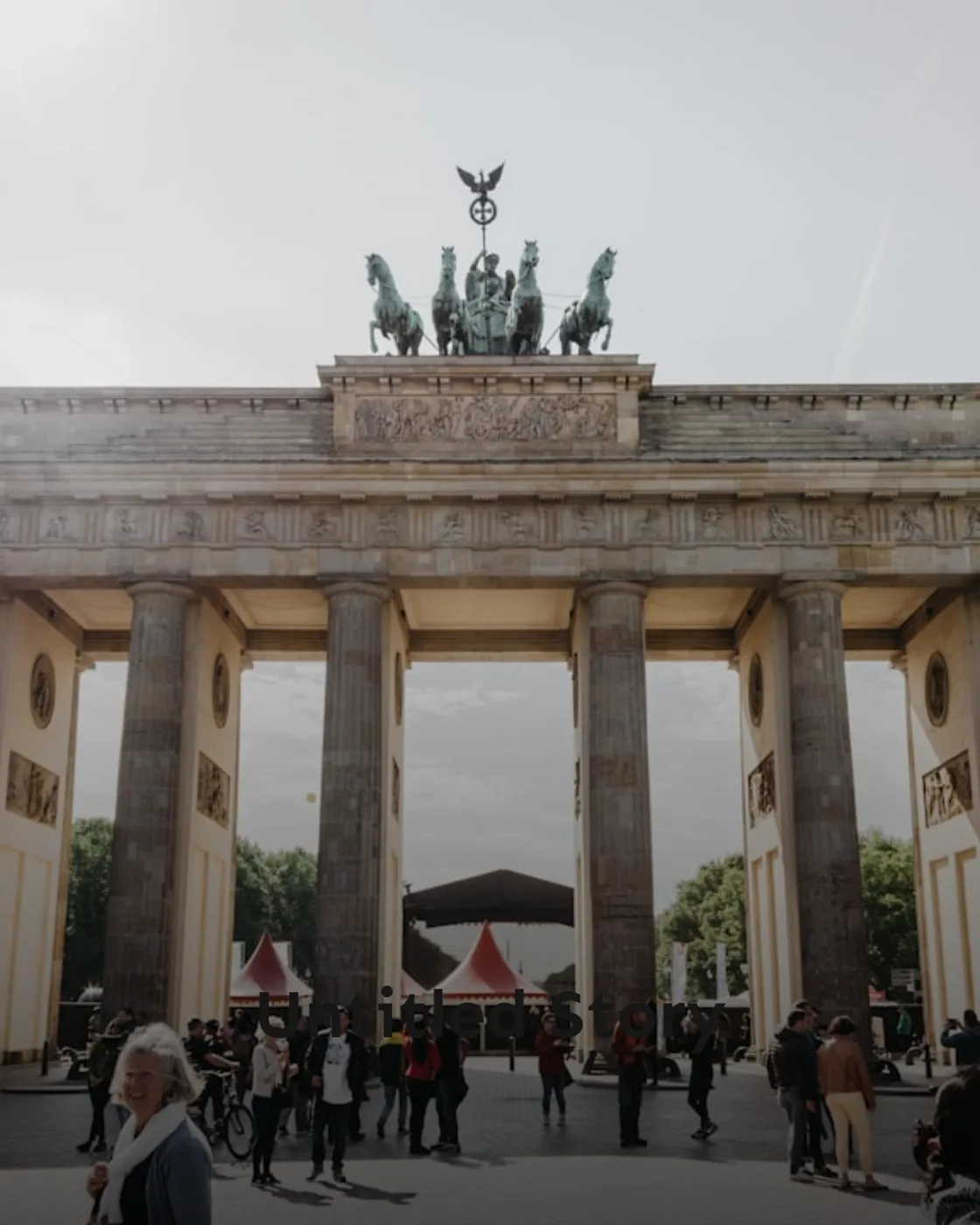
Stood in the kitchen stirring the kartoffelsuppe she looked out over the skyline. It’s not hard to imagine, she thought, of the fiercesome place this had been when the secretary, obedient in His lair, His acid womb of concrete, typed out with neat fingers His memos, His orders as if He was the chief executive of a small pan manufacturers, whilst the sound of war rolled the still rank air of the bunker. Despite everything Berlin still retained the memory of those days. It was the same now as it was then. She thought to herself Berlin is place that knows how to hide, how to keep its head down until the worst is over then stagger back up, brush off the dust and carry on. With a growing savagery a helicopter swung into sight, its rattling blades pummelling the air as it hovered at a level with the fourth floor windows, the fading sun silvering the windshield as its hidden pilots peered into their lives. The seven o’clock sortie, she mused, checking for miscreants breaking the curfew of Pandemic 3. Strange how we so readily accept the abnormal and accredit the bizarre.
It was that hand I felt when I woke up, if I had been asleep at all. God alone knows, no-one in here will tell me.
So why can I feel that hand. What was it about that hand that I can remember it over a hundred years later. It’s really odd to say that, to think that I have lived for over a century. Done all the things I have done though I didn’t do half the things I wanted to do. I never drove a fast car. I never sailed to America, never divorced my wife. Sure, I’ve seen a lot of storms and fires, been drunk more times than I’ve been sober, cried at the deaths of all my children, and yet that hand, as it touched the side of my face. Oh, I don’t know…I must have been tiny, four or five maybe and until then everyone’s hands that touched me were gentle, they stroked, petted and patted, chucked under my chin or ruffled my hair. But that hand tapped my cheek as if no-one had taught them how to be kind. Don’t get me wrong, it wasn’t a slap, no I’ve had plenty of them in my life so I should know but it was…was dispossessed of any emotion.
Could I touch the cheek now where that hand laid on me in its dead brevity? Try to find a vestige of its passing? No. even if I had the strength to lift my arms they have put a mask over my nose and my mouth, pumping life into my lungs or vacuuming out my soul, they won’t say which.
Mina would not let her go. When Joanna had first told her that she had to go out she screamed a prolonged siren shriek that seemed to come from some inner-cauldron of spite. But Joanna knew the pained depths of her suffering. You can stay with Mr Braun, watch whatever you want on his TV. Mina’s scream eventually became a hoarse wail until it died away. Then she sat under the table an immovable wedge of resentment. Joanna could neither talk nor drag her out. The problem was solved when Mr Braun agreed to stay in her apartment for a couple of hours. Mr Braun was Joanna’s neighbour and was much taken with wearing garish waistcoats since he retired from teaching. He appeared at the door smiling, unshaven, in paisley and carrying a copy of Die Welt rolled up under his arm. Mina glowered at both of them from under her refuge.
Twice on the empty U Bahn Joanna had her Virenfreier pass checked by serious young people with lanyards and plastic ID cards defining their new-found authority. She passed up the tiled stairs at Lindenauer Allee and walked purposefully down Waldstabe. The street seemed to have been cleansed of all humanity though she could feel the suspicious stares from the balconies above. The half-hearted attempt to snow. The Landesarchiv with its redbrick frontage reminded Joanna of a warehouse or a private school. Its door was hidden and the entry complex as if to test the resolve of its visitors. Once inside a starkly thin woman led her into an airy room, clinical in its whiteness with a damp winter sun glistening through its arched windows. The woman brought the worn blue envelope-folder she had requested, and with eager fingers Joanna unknotted the string that held it together.
The front page, brown with age and scuffed with use was headed, ‘Interview with Liesl Ostertag conducted December 1946 by Captain Archie McCallum, US Military Intelligence’. The typing was in thick ink and heavy-handed but Joanna could see that the interview had been conducted with a military efficiency. McCallum had clearly taken Ostertag through her experiences in the Fuhrer bunker day by day so it made for easier for Joanna to find the point in time that she was looking for. There it was, a dozen pages in, Saturday the 28th of April. There were the repeated lines about Eva Braun’s fastidiousness in her dress and make-up that morning, a complaint about the lack of fresh meat at lunch, and then in the late afternoon Ostertag goes up into the Reich Chancellery garden with Erich Kempka to have a smoke. Joanna ran her finger along the tightly packed lines, trying to imagine Liesl stood huddled under the ivy covered trees by the door, Kempka by her side wondering in their collapsing world what her fate would be. There was a volt of excitement, and she held her breath involuntarily as the words spoke out to her. Out of the bunker He came with Lindhoff, Gunsche and Dr. Hasse. Joanna could see it, the ruin, the smell of burning corpses and cordite, the unfathomable explosions all around. She told McCallum that all four stood nearby in silence. Suddenly a woman wearing a blue headscarf appeared crossing the garden with a small boy tugged and balanced by the hand as they stepped over fallen masonry. They were both gaunt and grimy, and Ostertag wondered if they all looked like that now, pride given way to survival. His party stopped the fleeing pair and He spoke to them, His voice low and unsteady. Osterlag could hear part of what the woman said. Her husband had been killed two days ago near Lake Schwielow. He had been a lieutenant with the Clausewitz Division, and now she was trying to escape the soviets. Ostertag didn’t think that He was really listening. Why would he, she told McCallum. One of the group asked her her name and she said something like Lehmann. Then suddenly He nodded and bent forward raised his hand and tapped the small boy on his cheek the way He always did. Joanna leaned back. A vacuous gesture of power and patronage, she thought, she had seen it so many times before on black and white films. That was it though. That is the person for whom she must search. Ostertag watched Him turn and descend in a painful parade of defeat into his underground refuge for the last time. The transcript had underlined ‘I almost cried’ as if that was an important phrase. Joanna started to work it out. If the boy were four then he would be…in her excitement her calculations stalled…over a hundred now. but if he were alive he would be the last living witness to Him. She knew she had to try.
Hanna leaned over the old man.
‘Is he still alive?’ she asked
The other nurse touched the pulse on his neck,
‘Just about.’ He replied.
Hanna checked the oxygen cylinder, ‘Still three quarters full.’
Ewald didn’t acknowledge her words.
‘I said,,,’
‘Yes, I heard,’
‘Why are we bothering.’
‘Because…’ he started to reply but justification failed him for that moment, and then in his hesitation the unconsidered words formed,
‘We need to.’
I can hear them, the voices yet the one that comes back is the quietest of all, like the lightest of birds landed on the thinnest of twigs. It is asking where are you going, each words frail, picked out above the faraway percussion of bombs. I can hear my mamma’s voice, still hoarse from crying, to the west she said. There is a silence, but a violent silence until that voice intrudes its one word, lacerating like a fractured edge of porcelain, ‘why’? It asked and mamma, long at peace now God rest her soul squeezed my hand for comfort, for love, for fear and I hear her just say, ‘we need to.’
With the laptop perched precariously on her duvet covered knees Joanne pressed the keys as softly as she dared. Beside her Mina was compact and breathing heavily. It had been another battle with verbal skirmishes broadcast to all the neighbours. What would Mrs Meier think? Then the digging-in and standing-off and finally peace. The military records came up. A Lieutenant Werner Lehnmann of the Clausewitz Division had indeed been killed on the 26th of April near Lake Schwielow. She switched to the 1942 archived census. It was a long trawl through the records. Her eyes became blurred and stinging with tiredness. Mina twisted under the duvet, and Joanna held herself immobile watching her daughter’s eyelids. She was not ready for another crazed confrontation. But Mina’s eyelids remained closed so after a minute Joanna resumed her search, scrolling the endless list of long-dead Berlin citizens. Finally, in Zimmerstrasse she came across the names at number 14, flat 6, Werner and Clara Lehnmann with their two year old son Harald. She played with the name searching for confirmation or meaning – Harald Lehnmann. This must be the child surely, son of Clara who dragged him to safety across the burning city, past sights no five year old child should witness. But she wondered, had they survived or had they been torn apart by a screaming salvo as they sheltered in a crater or trapped by advancing Ivans on the banks of the river Havel? Had they perished and all her efforts were in vain. Or had they struggled on amongst the petrified refugees drawn inexorably along the roads now barely scratch marks on the broken earth until with a mixture of relief and awe they saw the approaching GIs who stared at them with loathing and suspicion. Joanna did no know but knew she must.
They held hands. More accurately one hand was holding the other which was flaccid and cold. It made no effort to hold back. It may not even have sensed that it was being held. Ewald did not mind. His shift had finished an hour ago, and snow was piling up on the cars outside.
‘Harald,’ he whispered, not expecting to elicit a response.
The ventilator quietly hummed. He wanted to say the name out loud so the old man would know that someone was there for him, but Ewald did not know Harald. It was only the name he knew. One hundred and eight years, every portion of his life atrophied from the moment of birth , and now only the name was left. Ewald thought that he could discern slight movements beneath the sheets, beneath his skin; a leg moving in the memory of a step, a worn out heart feeble in its hopeless effort, a delicate lifting of the lungs. Ewald wasn’t given to pity, working in a home for the elderly had suppressed any sensitivity he may have harboured. But this once. To witness the old man clinging on alone. Just this once. He knew it was too late to stitch together the history of who he was so that cradling of his hand and the saying of his name would be the only testament to his existence. ‘Or a non-existence’ thought Ewald as he held the bony hand that had scraped at so many surfaces in a lifetime but never left a mark. ‘At least he deserves this bit of my time’.
The first person had tapped encouragingly on the door but the second person, though it could have been the first person again, had knocked with some irritation. Joanna had boarded at 8.15 whilst Mina, she hoped, was still asleep at home. Mr Braun was away visiting his daughter in Filderstadt so she felt that she was compelled with no choice. Once the train had slipped out of the city she watched the wonderful madness of the fields pass by until she became bored and picked up a free newspaper. She read about celebrities. The man in the next seat whom she barely noticed earlier in the journey had pulled down his face mask and began efforts to talk to her. He smelt of cologne. Keeping her eyes fixed on the paper did not deter him and she became uncomfortably aware of his sidelong stare at her breasts until with a huff of annoyance she upped and left her seat and locked herself in the toilet. And now she wished she hadn’t. Trapped in the stinking bunker, knees bared as if to justify her presence, the rhythmic pitching train unsettled her until her thoughts once more started to torment her. Inside of her head it felt to her like a tangle of wires plugged only into themselves. She knew Hitler was a monster. Everybody knew that. No-one spoke of him, looked at his image or read his words. And yet perpetual thoughts of him always cut through her rationality like a blunt saw. Her placid demeanour and ordinariness had never betrayed her inner obsession with his madness. So why had this demented, unmentionable figure taken possession of her mind? She knew that he was dead and distant but she thought that if she could only look into the eyes of the last person alive to see him, to hear him, feel some sort of connection perhaps she thought that she could placate her mind and drive out her demon thoughts. There was no sense nor logic in this reasoning, even she knew that and she recognised in her muddled mind that this was possibly a poor excuse to draw closer to Him. But regardless she was on her way, cloistered in piss and surrounded by insanitariness, and the third hammering on the door.
It's not as if he comes in my dreams because he is always there, a featureless face palpitating greyly not centimetres from my eyes, and I fight to make that face clear but it will not resolve. Mama said I was special once upon a time. And somewhere I make a connection with me being special and the dissembled face. unless it is all a fantasy, a delusion and that my condition has made it so, has convinced me of its persistence when all it is are the deprivations that I now suffer. I no longer am sure it has anything to do with the tap on the side of my face that time. I once thought that it was, that there was an interconnectedness that had meaning. But here I am masked and unable to complain or smile, pinioned by age under the brutish blankets from making even the slightest gesture. Not that anyone here would listen or give a toss or notice these petty apparitions flitting in and out once in a while with their banal mutterings. Oh, stop your blubbering man. Am I blubbering? It’s hard to know. I didn’t used to, found snivelling demeaning but these are changed times and I am weak beyond contempt I’m still the man I used to be but no longer the same person. Any specialness must have grown smaller before all these wretches. Hands. Faces. that’s all I have left. Yes sir. All I have left.
Joanna had no intention of tracing the journey Harald Lehnmann had made through his life to end up in the innocuous town of Nordlingen. It was of no interest to her whatsoever. All that mattered was that one meeting in April 1945 and now. Online archives had quickly shown his existence through his date of birth, and his whereabouts tracked down to a home for the elderly. She tramped the pavements through layers of grey slush which soaked her shoes. Mina would be awake. Joanna hoped that she would be happy to have the place to herself. She could get her own breakfast, any bizarre concoction that came into her head, put on her Xbox and clamp the head phones over her ears. Yes, thought Joanna, she will be fine. She could hurry no faster towards the outskirts of the town, her eyes following the map on her mobile, her feet slipping and calves aching.
Ewald stepped back inside the home. He had not slept well that night. No reason, just a topsy turvy night, cold between his sheets. Hanna was stood at the reception desk, she did not smile or say hello but hung her head looking uncomfortable.
‘You OK, Hanna?’
‘I’m sorry, Ewald.’
‘’Sorry? For what’
‘It’s Mr Lehnmann.’
Joanna eventually found the entrance to the driveway tucked between a Pizzeria and a pet shop. She had rung ahead yesterday, they would be expecting her. His distant relative she had said not minding a bit of deception.
‘We needed his ventilator for Mrs Westergaard.’
‘So you…?’
‘We needed to.’
‘But…’
The heavy entrance door opened behind them.
Mina screamed.
Story complete!
Enjoyed this story? Sign up to like it, save it, and support the author.


Discussion