

The Wind
Listen to The Wind
Checking audio availability…
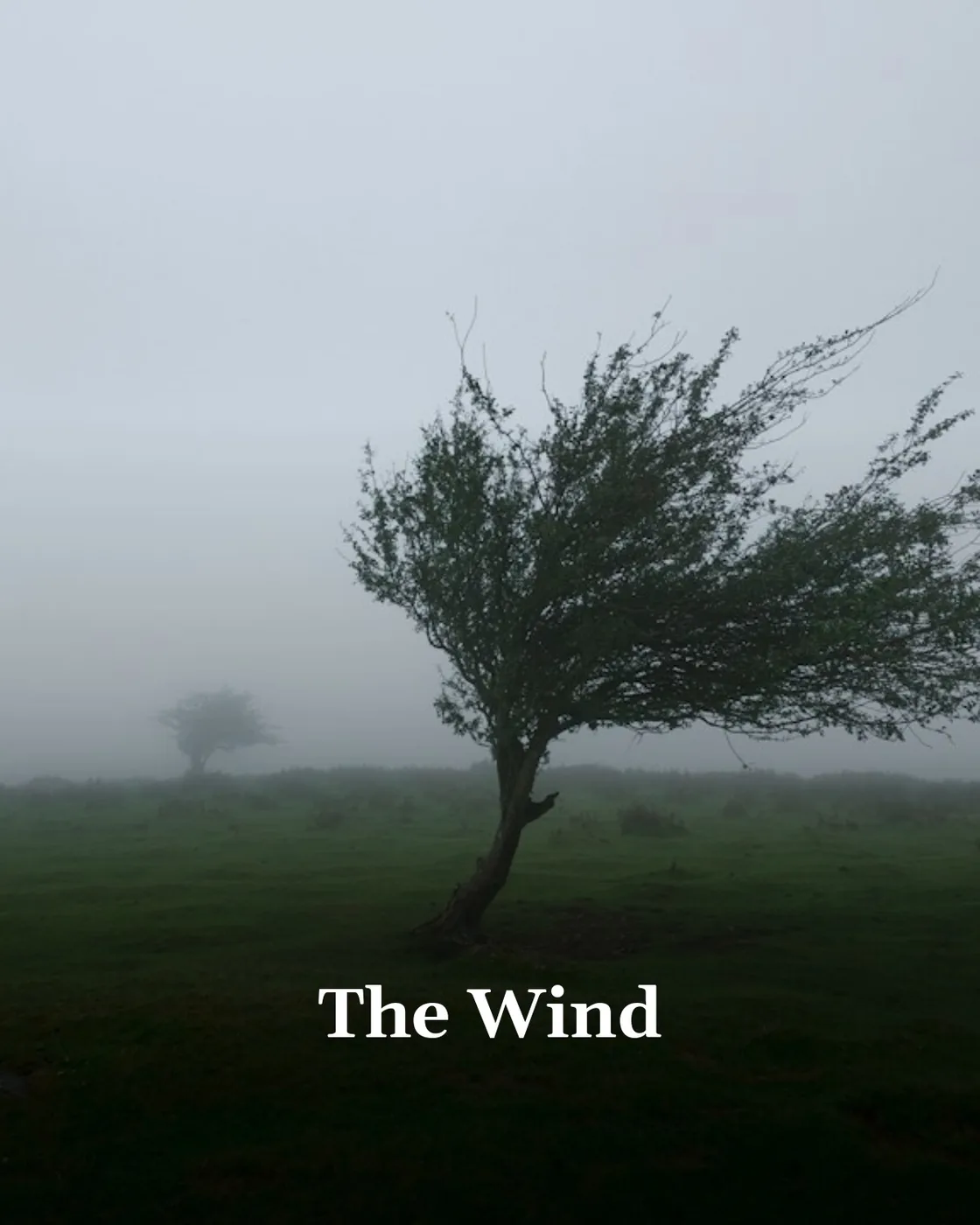
Free as the wind, they say. Oh, easy enough to say “the wind,” but is the wind ever really free? Look up at those curls of cloud chasing one another and changing shape, now wild horses, now steam trains, now Babylonian archers making love: it’s the wind that blows them, shaping them the way a child shapes clay, but who blows the wind? Air, as everyone knows, is always hunting for empty spaces to fill, and in moving it leaves countless new ones behind, which fill in their turn, and so on and on. Space is a blanket too short for the bed, and tugging at it stirs up a draft. From that restlessness the wind is born, from the sense of a void, just like us, forever setting out after something our lives lack. We are the wind that slams into the mountains; funneled down into the gorges, we howl the pain and anguish of those who find no rest.
And here he is, my wind, a lame old nag crumpled inside a tunnel outside Sansepolcro, still steaming, the stallions bolting past him, whinnying; the life is draining out of his body while I stare, dazed, the red warning triangle in my hand, unable to move. From the gutted cab my thoughts drift out like opalescent ghosts, a brittle, faded film under the dull roar of the trucks, and a rosary of curses rains down on me from the vehicles swerving around us. My life up in smoke, I think, and with one finger I wipe a tear of blood from my eye.
Then suddenly there is a hand on my shoulder; I flinch, I whirl around, and for a moment the Carabinieri uniforms reassure me. One of them gently lifts the triangle from my hands, which are cold as the stone of the mountain we’re standing under, and the other steers me toward the door of the camper, climbing the step behind me. Our eyes travel over the devastation of my small world. The man in uniform looks and says nothing. Caspar and Melchior, I think, smiling at the two of them, while out there the sun goes down on the eve of Saint Lucy’s.
I got lucky, I think. The windshield must have shattered an instant before my head could smash into it; I can see the engine peeking out from behind the dashboard and I almost doubt I’m alive. All around, papers are strewn across the floor, the stove, everywhere, quotations copied out by hand at the tables of who knows how many cafés. The chassis groans and buckles in on itself, a deafening hair shirt of memories hooking into my brain, and I can barely make out the voice of the officer asking for my papers. Sure, I say, one second. Melchior is calling for help, and strange as it may sound, I feel safe between these two men in uniform, at least until the other one comes back to the paperwork, studying me a little sidelong, and:
“You live in here?” he asks. I put myself in their shoes, and how can I blame him? The camper’s plates have sat in plain view outside the squats of half of Italy for months. The political squad must have put together a more than respectable file on me, to say nothing of the notes now ground under the soles of my combat boots.
“Yes,” I answer. “Street musician.”
I look at him, half offended, half surprised, wiping away the blood that keeps running from my cheekbone. I caught the rearview mirror in the crash, but the two officers don’t seem very interested. As far as they’re concerned, I can walk, therefore I am. The man under the uniform waves me out with a nod and points to the patrol car; I follow him, leaving the carcass to the vultures, we get in, and, wind blown by another wind, I let myself be carried.
The car pulls out like a cold north wind, discreetly, without howling its unsettling two-note dirge, monodic and obsessive, and works its way out of the tunnel’s throat and back to blowing over the snow-pearled valleys around Sansepolcro, slipping between a few trucks and the thin traffic of a lazy, drowsy December Sunday. We pass through the worlds strung along this artery full of potholes, bumps, and grades, balanced on the thread of viaducts that yet another wind slaps without mercy. A snow-dusted crèche. The two Magi in the front seats, mute, impassive, the only sound an occasional squawk from the dispatch radio, a few distant voices, tinny, as the car glides along, sure-footed, over a sea of clouds. I watch the signs go by for Città di Castello, Perugia, but where are these two taking me? Near Terni the gust slows, the car takes an exit, climbs, descends again, and after what feels like an endless time glides in between two sleeping ambulances under a canopy. I recognize the sign for the Emergency Room. They motion me out and guide me through the hollow, ghostly corridors of the hospital, where a few paper bows and a bit of glitter on the windows remind me that Christmas Eve is a couple of weeks off.
Waiting to receive me is a fat, bejeweled man in a white coat who looks like the innkeeper of the Nativity: two long mustaches curled at the tips, black hair crowned by a shiny bald patch, a face very pale and yet lively, emphatic, expressive. He smiles as he settles me into the reclining chair and, rattling off adventurous tales of coming home from vacations, punctuates his words with the grimaces of a seasoned clown. He says he’s going to sew me up a nice darn, as if I were a sock, while Caspar and Melchior, silent sentinels, stand watch, one at the window, the other seated, fiddling with his thoughts.
“No, no, hold still like that,” the innkeeper urges, working the needle into the skin under my eye; then, maybe to distract me, he launches into a long-winded solo while, fussing a little above the cheekbone, he shakes his head and white dandruff snows down on his shoulders. “We camper people, we understand each other,” he says. “Every time we hit the road there are six of us, me, the wife, the kids, and the mother-in-law, in one of those with the bed over the cab, a double up top and two singles down below, the girls bunking head to toe, see? Ah, freedom!”
I eye Bacchus sidelong, dazzled by the lamp. Free, sure, I catch myself thinking as his voice fades into the distance, free as a little breeze snagged in the branches of a campsite on Lake Trasimeno. A part of me has stayed buried under the tunnel at Sansepolcro, and who knows where they’ve taken it by now. I feel split between here and a nameless tow yard somewhere in the Umbrian Apennines, six years of notes at the mercy of the water and the night dormice. I couldn’t take anything with me, and the first passerby gets Christmas and Easter rolled into one. Hurry up, for God’s sake, it’s raining, we have to move fast! Maybe, I tell myself, I’ll set up at the yard for a few days and write from there while the mechanic looks after the wreck; yes, that’s it, I’ll bring him coffee, a nice pine-nut cake, maybe he’ll even let me use his toilet.
Meanwhile the twister that hit me under the mountain starts blowing again; Bacchus hands me back to the camel drivers from the East, who guide me once more through the maze of hospital corridors and load me into the patrol car; a few blocks on, I watch the automatic gate of the barracks slide open. I thought they were taking me to the yard, but no. Melchior, silent as ever, opens the door and walks into a drab, heated little room with a Carabinieri calendar on the wall; he sits at the desk, boots up the computer, starts typing. He asks no questions, he has it all clear in his head: tic tac tic tac, but what could he possibly have so much to write? It can’t take much, a hippie who slams into a truck in a tunnel, small potatoes. My eye wanders as I wait, over shelves full of binders, folders, documents, across the desk, and trips on the photo of two radiant little girls on roller skates. Two marvelous dancing putti.
“A signature here, one here,” he finishes, handing me the forms.
I read, I reread. Citations, fines for I don’t even know what, one of them flat-out defying the laws of physics, since my cart is a rattletrap that tops out at ninety kilometers an hour on the highway. I don’t waste time arguing, the word of a bum against a report by the Magi, no less. I sign, I pocket.
“Okay, you can go,” says Caspar.
“Go?” I ask, incredulous. “Go where?”
“You can pick up the vehicle in sixty days,” Melchior clarifies.
“Sixty days,” the other spells out.
“Pick it up?”
“Sure, at the impound lot in Sansepolcro,” he explains.
“Sansepolcro,” the other repeats.
I hear the wind drumming on the glass as if to say come on, come on, rolling in little whirlwinds. Mid-December, and out there the crèche is waiting for me, a wandering shepherd boy in a black wool turtleneck stiff with my own dried blood. I take a long breath.
“A ride to the station?” I ask.
“That’s not procedure,” they answer in unison.
Melchior points to the door. When I step outside, the drizzle has turned into an icy hiss. I look around; I must be somewhere on the outskirts of Terni, which at the moment is a deadly labyrinth, a dazzling full moon standing over it like the Magi’s comet. Seven degrees, give or take. I have to find my bearings in a maze of identical buildings, and the only option is to keep going straight without ever turning, I have no time to duck down side streets blindly and I don’t know how long my body can take the cold. If I keep heading the same direction, sooner or later I’ll find a sign for the station. I set off one step at a time, every third step stamping my foot, right, left, so the sleet can’t work its way into my boots, swinging my arms like the foot soldiers of a cavalry regiment, using every tree, balcony, cornice, awning, and porch to find shelter for even two or three yards.
Now it’s my thought that turns to wind. As I walk, shadowy figures appear to me, the floating silhouette of the Colosseum just as if I could see it down there at the end of the street; it dissolves for an instant at a dog’s bark, and the outside blurs into the inside. All of a sudden I see myself before the drawbridge of Forte Prenestino, among the housing blocks of the Roman borgate; right foot, left foot, left, right, the sharp smell of the dormitory in the abandoned military fort and the smell of beans at the people’s tavern, I feel them drifting through this squalid Umbrian suburb. I match my breathing to the rhythm of my steps while the sleet turns liquid, thick fog mixed with a light drizzle that the gusts whip into my face. Beneath a tree-lined overpass I pass the shuttered shop of a mechanic, where a big drum of used oil reminds me of a smooth cowhide stretched over a tin like that one: a lone wolf (it seems like yesterday) used it to accompany his singing in the train underpass in Milan, a danse macabre of strays in the rain.
In that jumble of faces, voices, shadows, I seem to see myself on a subway car, on Christmas Eve; the doors close, the car rattles along, I sing “Tu scendi dalle stelle” to the brooding, bored passengers, banging a moped’s exhaust pipe with the cap of an empty bottle to keep time, and the bottle fills with change. Like a dream, a glowing row of takeout counters delights me with the smell of pizza by the slice and hot supplì, while shapely Khazar dancers belly dance in a shop window; I get off at my stop to the applause of the passengers, only to shut myself in, right after, behind the toilet door in the shit-caked latrine of the Fort. Then the fog evaporates and in the distance appears (for real this time) the station at Terni, crowned by a plump, benevolent moon and a big fir tree decked out for the holidays.
I resolve to hop the first regional train for Rome after midnight, just like in the dream. Walking into the station, I feel people’s eyes stick to me; I sort of understand, with my cheekbone bandaged, dried blood on my sweater, and not a coat to my name, I can’t be making much of an impression. The waiting room blazes with blinking lights, and from the departures board I take note of a bare Formica seat scheduled for 1:07, change at Orte, I’ll be at Tiburtina by six. I should have just enough time to conjure up a vaguely musical contraption, piecing together whatever I find. Scrap iron, cigar boxes, broken toys; if I can catch the first gust of commuters around seven, car after car, by evening I could squeeze out of it a lean kit: a sleeping bag, a change of underwear, soap, a towel. Then the tavern and the dormitory at the Fort.
I have a couple of hours before the train. I step up to the little window of the newsstand (which is also a stationer’s, not to mention salt and tobacco), get myself a pencil, an eraser, a sharpener, a notepad, then go into the café and order a coffee; the attendant hands me a chocolate with a bearded face on the foil wrapper. I sit down, in an unreal calm. Right there at that round little table by the window, the wind comes back to claim me, I hear it whistling through the gasket at the bottom of the pane, the air seeping in, anxious to whisper something in my ear: it sings of wild horses, steam trains, Babylonian archers, opalescent spirits wandering disconsolate through the night of Christmas Eve. I take out a sheet of paper, sharpen the pencil, and begin to write, cross out, correct, rewrite; an air for solo voice takes shape in my ear, and in my head I fit quatrains of seven-syllable lines to it, jotting quick notes on a lopsided staff, just so I won’t forget the melody. The wind doesn’t stop blowing.
Story complete!
Enjoyed this story? Sign up to like it, save it, and support the author.

Discussion