

The Painter on the Road to Tarascon
Listen to The Painter on the Road to Tarascon
Checking audio availability…
The Painter on the Road to Tarascon
The back room of an antiques shop in Edinburgh, Scotland. October 1982
Robert was not an expert in paintings, his areas of expertise were Victorian heavy wooden furniture, anything silverware related – in particular Georgian spoons (he knew all the maker’s marks and assay offices, and could recite most of the hallmark letters from about 1690 onwards). He was also interested in fine jewellery, military medals, and good quality English and Japanese porcelain and china. Every antiques dealer knows their own strengths and Robert generally stayed out of
paintings, but at the same time, he felt he had an eye for quality, and if he saw something that were a steal he would still dabble; but independent art experts were required to corroborate authenticity on fine art paintings and with the growth of x-ray and infra-red analysis it was all just getting too technically complicated to keep abreast of, especially at the higher end of the spectrum. Still, Robert knew a few old tricks.
He poured a whisky, and stared out of the back window into the torrid night beyond. He had closed up the trade-shop around half an hour before, bolted-the doors, and put the alarm on at the front. It had been a strange day so far, and had begun early that morning when he had been rousted out of his sleeping berth by an impatient British Rail steward on the overnight Motorail service from
London. He had fought through his mounting hangover to drive his Volvo estate off the train and up the short distance from Waverley station to his unassuming lock-up on the edge of the city centre, a journey of literally a hundred seconds at that time of the morning before the rush-hour. In the back was a haul of objects he had procured from other dealers in London. Boxes of Victorian silver tea sets, candelabra, porcelain pitchers and ewers, some other bits of china and one post-impressionist painting that his brother who was still in the army was looking for a second opinion on. He lifted it out of the box and placed it on his examination table and switched on the fluorescent lights. It was quite a small picture, about the size of a large pizza box, and mounted in a ridiculously oversized gold leafed frame. He hadn’t actually bought this one, but had lodged £1,000 with the pompous bondsman in London to allow it to be taken up north for valuation. It still belonged to some people in Argentina whom his brother was liaising with, they wanted an honest opinion on what it could be worth without necessarily hawking it around the whole antiques trade. It was a sensible move, the Scottish market was smaller but the vendor would still get a realistic test of the UK market, and an indication of the present value. Likely as not it would probably go to Sotherby’s in London in an
auction the next month, but if the price was right – Robert and his brother might be able to get in on the deal before it hit the public market, and that’s where Geoffrey would be coming in.
Geoffrey Bonamie was one of Edinburgh’s best known antiques dealers whose reputation preceded him, an eternal bachelor and openly homosexual which was an unusual thing in those days. Geoffrey dressed in velvet suits and modelled himself like a character from an Evelyn Waugh novel. He had a handsome shop on the tourist thoroughfare of Rose Street, and was very much the showman to Robert’s more deadpan, straightforward way of dealing. Robert was astute, but his
approach to business was to buy and sell quickly, and generally only to the trade. Robert would rather make 10% on six sales in a day, and buy another six items the day after; whereas Geoffrey would hardly ever buy anything, and instead had a shop full of overpriced items that hardly ever sold at all. When they did however, his margin was more like 300% - Geoffrey’s business philosophy catered only towards star-struck tourists and impulse buyers who didn’t quite know what they were doing.
Although Robert and Geoffrey were technically rivals, and hunted for new stock at the same trade auctions as each other, their approaches to the trade were so different that it often enabled them to work together in the aftermath. Robert would find the articles, Geoffrey and he would argue about how much it was really worth once Robert had bought them, Geoffrey would then eventually pay 10% more for it, and stick it in his shop window the next day at four times the price, and if he were lucky – quite often months or years later it would sell for an extortionate amount and Geoffrey would get his reward. Geoffrey had the better patience, but Robert often grabbed the best goods before he did. Robert had never found anything quite like this though, and he began carefully prizing the canvass out of the frame, slitting open the mounting tape and easing it out. He knew what art
dealers looked for: there would be all sorts of clues to its provenance on the hidden edges the public weren’t meant to see. Just then as he was pressing it out of the frame, a small label not that much bigger than a name tag slipped out of the gap and landed on the floor. ‘Here we go – first clue of the day’ – he thought to himself.
Kulturhistorisches Museum Magdeburg
‘Ha – Germany. But good enough to have once hung in a museum at any rate?’ Robert smiled to himself, he knew he had an eye for quality. Still, £1,000 was a lot for a painting that no one even knew the artist of. Robert drummed his fingers on the table and began considering the clues silently in his head: the post-impressionist era began around the turn of the century, well it was in full swing
by then, the pioneers were beginning it twenty-five years before that, in truth it overlapped with Monet, Manet and the whole the impressionist era but never hit the mainstream until later. How did the painting get from Germany to Argentina? This puzzled him and sent a tingle up his spine. It was a handwritten label, at least forty years old judging by the yellowing, probably pre-war, and had been
gummed into the side edge of the frame in total obscurity. Robert had taken enough canvasses out of frames in his lifetime to know when they had recently been replaced, this one hadn’t been and was very tight to its apertures, belaying years of swelling to the seasons in a temperate climate. To his mind, this wasn’t a plant by the vendor attempting to get a professional valuer excited, this was
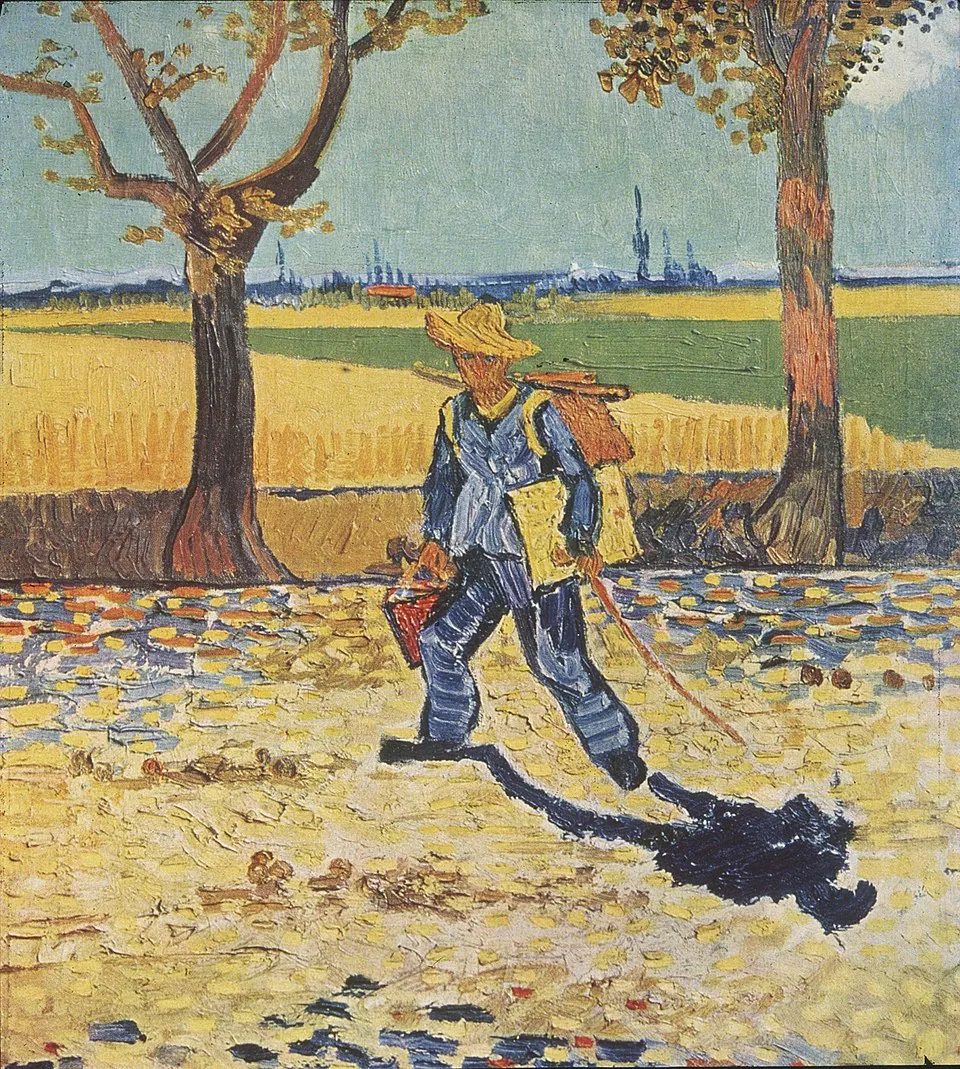
the genuine article. He put the label to one side, and then picked it up and looked at it again and sniffed it: handwritten, faded black ink, that old-fashioned glue smell with a hint of fishiness that you didn’t often get anymore, he stroked it between his fingers and pondered the situation and then started looking at the painting again. A man walking down a sunny road from right to left in bright summery hues of orange, yellow and red, probably late nineteenth century he thought. Oils on plenty of gesso, broad brush strokes, plenty of texture. He flipped it over and brought over his magnifying glass and looked at the back of the canvass: a plain weave, not cotton though – this was an old-fashioned linen blend. ‘When did cotton come in?’ – Geoffrey would know.
He picked up a heavy black telephone, and started dialling his brother. His brother knew nothing about art, but was a shrewd businessman when he wanted to be.
“It’s Robert,” he began in his signature Anglo-Scottish drawl. Robert and his brother’s accents were essentially Scottish, but cross-pollinated by a mixture of second division private schooling, the annunciation of the British Army officer class, and in Robert’s case the provincial teuchter whine of the home clearance and second-hand trade. “That painting I’ve got, talk me through exactly how you got it again?”
“Right, well, when we were interning the Argies on the Falklands a few months back after the war was over, I got friendly with this one chap who said he had a painting that he was trying to get sold in Europe for his mother. He’d tried to get it sold in Buenos Airies, but was just getting silly offers all the time, said he didn’t think they understood how good it was. He thinks it might be worth over £1,000 but everyone’s broke in Argentina at the moment, currency has completely crashed since they lost the war. I told him: ‘my brother’s an antiques dealer and he might be able to help you, he could get it sold in pounds sterling’. It just sort of went on from there, and we exchanged numbers before he got returned to the mainland, but when you said you needed to see it and a black and white photo wouldn’t do, that’s when he started getting a bondsman involved, and shipping it over. Must have cost him a bit? He’s really serious about this.”
“Yes I can see – he’s really gone to some lengths.”
“Have you worked out what it is yet?”
“Still working on it, I’ve got a chap coming round who knows a bit more about these than me though in a minute so stand by.” Robert scratched his head, “can I ask a serious question?”
"Go on?”
“This Argie buddy of yours: how did you two develop such a sense of trust with each other?”
“He’s called Victor, and he’s not my buddy,” his brother returned gruffly, “and he doesn’t completely trust me or he wouldn’t be using a bondsman.”
“No, I mean; before then – on the Falklands. How did you get talking to a captured enemy soldier about paintings?”
Robert could hear his younger brother’s tone change, “you weren’t there Robbie! Trust me, it’s nothing like Northern Ireland.” Robert gritted his teeth, he had served with the regular army for ten years but his younger brother was a Royal Marine and very fond of reminding him he’d never been in a ‘real war’. “I literally had him at the end of my bayonet when the Major blew the whistle, a second later and he’d have been a pin cushion.”
“So you spared his life when they were surrendering?”
“At Goose Green, and we lost good men that day. I had the red mist and everything, and had already taken a few to their maker. He would have been the next one had the C.O. not seen their white flag and called cease-fire.”
“I get it, that’s why you two have that relationship.”
“I’m glad you understand Robert, it’s a brothers in arms thing,” Robert rolled his eyes, it was as if his brother could see him doing it down the other end of the phone, “look I’ve got to get ready for this evening, I’ll have to go – function at the Army and Navy Club on Pall Mall, Mrs Thatcher is going to be there, and Prince Andrew.” Robert rolled his eyes a second time, they exchanged a few muted last pleasantries and ended the call.
Robert was puzzled, this Argie was a character. Going to some lengths with a solider who’d nearly killed him to establish a correct value on a painting where no one had a clue of the artist. It was a nice painting, but there were hundreds of unknown artists out there who never quite made it.
He scanned the edges of the canvass one more time, normally there would be an autograph or something to give a bit of a clue, even a pencil signature on the back; but this one had no autographs on it that he could see. The backdoor bell rang shrill, jolting Robert out of his pondering.
“Ah Geoffrey, come in.” he opened the door to the man with brolly and rain mac, “can I offer you a drink?”
“No darling, I’m fine, I’ve had three banana daiquiris this afternoon, couldn’t possibly have another. How’re you anyway, business doing well I trust?”
“Not bad thanks Geoffrey, I’ve just come back from London.”
“Oh London! How fabulous...”
David ignored Geoffrey’s mincing overtures, led Geoffrey over to his examination table, and put his whisky glass discretely over the top of the German museum label. “Well, what do you make of that?”
Geoffrey’s eyes darted over the canvass for a few seconds, and he then turned his nose up. “Very nice, very nice; but it’s not for me. I don’t deal in copies, have you got anything else?”
“Copies?” Robert began
“Yes copies,” Geoffrey continued, with a titter.
“Why do you say ‘copies’?”
Geoffrey stood still for a moment with a curious air “you’re not going to play the dumb laddie with me are ye?” he said chiding Robert him a wink.
Robert was lost for words, “Geoffrey – I literally have no idea what you’re talking about?”
“Well, this is a famous painting don’t you know?” he began, as if he thought Robert were jesting with him, “this is The Painter on the Road to Tarascon by Vincent Van Gogh.”
Robert looked back at the painting and back at Geoffrey, who carried on like he was explaining the obvious to a dunce. “It went missing in the war, presumed destroyed in a fire in some underground salt mine where the Nazis were hiding their loot.” The hairs began rising on the back of Robert’s neck, “copies of it come up for sale every now and again, and people often claim it is the
real one, but so far they have all been proven to be fakes.”
“Of course,” began Robert carefully, “but if you wanted to go down the road of proving it to be a fake, what would you do next?”
Geoffrey looked at him in befuddlement as if Robert were asking him to prove a stone were a stone. “Well, art copiers build up their pictures in heavily researched squares and layers. It’s not always possible to see without x-rays, but normally with something like this you would have a grid applied by a mechanical pencil in perfectly straight lines right on top of the gesso, then the outline of the man and the trees would be traced rather than hand drawn with expression. I don’t even think Van Gough sketched his paintings, he probably just went straight in with the paint like Picasso. Above the sketch each grid square would be coloured effectively like a paint by numbers exercise starting from the top corner and working most probably left to right, and you would see those grid squares appearing with drying lines at each junction under x-ray, and finally Van Gough was famously left-
handed, and although these brush strokes may look like they’ve come from someone who is left handed, the chances are the leading edges will be all the wrong way around if we look under a stereo microscope.”
Geoffrey looked back at Robert triumphantly, as if to say ‘was that what you wanted to hear?’
“And if we were to embark upon doing something like this, do you know anyone who could help us?”
Geoffrey looked flabbergasted, “Robert, this is going to cost hundreds to get x-rays done, maybe over a thousand. It’s a nice replica don’t get me wrong, but you know as well as I do the art copying market is dead. No one wants these things, and those who do will only want to pay about two hundred quid for them. Why would you spend all that money on proving it’s a fake? How did you even end up with it anyway?” Geoffrey was now pouring over the canvass in every detail, bringing his
eyes level, examining the edges.
“Is this the frame it was in?”
“Yes.”
“Very tacky in my view, gold sunflowers in relief, and far too oversized for a small painting like this.”
“Why doesn’t it have a signature?” Robert asked gingerly.
“The painting? Well, how should I know?”
“Well I mean, if it’s meant to be a copy of a Van Gough, wouldn’t they put an autograph on it as well?”
“Van Gough only signed the pictures he really liked, a lot of the stuff he didn’t like he destroyed or wouldn’t put his name to. He was completely unhinged you know? Chopped his own ear off and gave it to his favourite prostitute at the local brothel.” Geoffrey threw his hands up in a gesture of mock despair, “I cannot remember if this was one of the ones he autographed or not. Do you have an art book here?” Robert racked his brain, “Anything will do, this will be in all of them.”
A dusty old hardback was retrieved from a pile of other books at the back of the shop, one that hadn’t been opened in years. It had The Painter on the Road to Tarascon in full colour over a full page spread in the Van Gough section, the picture frame had rather annoyingly been cropped out of the image, but it did not appear to have a signature visible in any of the corners, and the two concluded that it was unsigned and most likely not thought to be worthy of an autograph from the
big man himself. It was also recorded to both men’s astonishment when a measuring tape was found as having the exact the same dimensions as the one they had in front of them – 19 inches by 17 inches. Then Robert saw something in the book’s description that really got the hairs of standing-up on the back of his neck, and he reached over to his whisky glass and lifted it up.
“Do you know what fell out of the side of this when I took it out of the frame?” Robert passed Geoffrey the slither of paper:
Kulturhistorisches Museum Magdeburg
And the two of them re-read the passage in the book: Status: Missing, presumed destroyed during World War II, last held at the Cultural History Museum in Magdeburg, East Germany.
Geoffrey’s breathing changed, and he looked back at the label, and the book again before turning to Robert and saying: “are you having me on?”
“No I’m not,” Robert said very quietly, and it’s possibly relevant that I tell you now, I don’t own this painting yet, I’ve got it on bond, and the person who does own it is some woman in Argentina.”
Geoffrey gave Robert a look like he’d just sat on a wasp.
* * * * * *
A quiet back room in The Ensign Ewart pub in Edinburgh, Scotland... About a week later
Robert fiddled with his ‘soup and a sandwich’, he hadn’t started it yet. He hadn’t slept properly in days and could feel himself coming down with a cold. Geoffrey walked into the pub in some ridiculously effeminate suit, and immediately acknowledged him, as the whole boozer quietened at the entry of this truly out of place entrant. Under normal circumstances Robert would have wanted to have the ground swallow him up at having been recognised by Geoffrey Bonamie in a
regular establishment such as this, but these were not normal circumstances. Geoffrey was carrying with him a heavy looking portmanteau full of documents and sat down at the table. He had a face like thunder.
“I would’ve got you a drink, but I don’t think they know what a daiquiri is here.” It was Robert’s best attempt to cut through the tension. The pub’s occupants had begun talking again, and were thankfully ignoring the two.
Geoffrey glared at him, “right now I don’t know whether we should be drinking champagne or cyanide.”
Robert blinked in confusion: “What did the tests come back with?”
“It’s not a copy,” Geoffrey said quietly. Robert straightened his posture, “well not like any copy I’ve ever seen.” Robert urged him to continue with his stare, “there’s no grid lines, no ordered drying layers, the whole thing has been painted organically from start to finish, possibly all in the same day,” the hairs started coming up on Robert’s neck again, “it might actually be a real Van Gough.”
Robert looked back at Geoffrey in disbelief, “what about the brush stokes? Were they left handed?”
“They appear left handed.”
“What do you mean?”
Geoffrey winced his face “Well, it could have been a left-handed copier, or a right-handed copier could have turned the canvass upside down and painted it in reverse order to give the impression of a left handed paint.”
“And done all of that in one day?” Geoffrey rolled his eyes in a gesture of defeat.
“I don’t know Robbie, I just don’t know!” He whined.
The two men sat there staring at each other as the adrenaline began to rise, and it was Robert who started first: “I was at the National Library earlier today, found the picture in about sixteen art books, about half of them showed the picture in its frame, and it is identical to the one we’ve got,” Geoffrey rolled his eyes back at him.
“They could have copied the frame as well.”
“I’ve been researching prices recently.”
“I have too, but you’ve got no paperwork with this one. It’s Nazi loot, and a lot people don’t even think it should exist.”
“The private market is approximately half the price of the public, and there’s no tax or commissions to pay.”
“But that’s not yours and my scene Robbie!” hissed Geoffrey.
“I know a few people,” threatened Robert looking around the pub for eavesdroppers, “look – Geoffrey.” Robert heaved, “We could be looking at fifteen million pounds if we could get this into Sotherby’s or Christies’s, even if that’s halved by the private market that’s still seven! I’ve got an Argie here that I’m trying to keep cool who thinks it’s only worth one thousand pounds; you can have a cut, I can have cut, my brother has to have a cut, and any art expert, dealer or contact you know who can find a buyer can have a cut too. There’s money for everyone here, and I’m not greedy, but I’m not just bloody giving up on this!”
“Robert, Robbie!” Geoffrey hissed looking around again for eavesdroppers, “you don’t know what you’re getting yourself into here. You’ve got to be very, very careful. If it gets out that that painting’s been rediscovered and you’ve got it, it will get confiscated by the authorities, and you and your brother will be questioned. He’ll probably get kicked out of the army, and the painting which technically still belongs to the Cultural History Museum in Magdeburg will get sold to charity and the only people making any money from it will be the East German Government.”
“Well they can get to fuck!”
“My thoughts exactly,” returned Geoffrey, and the two of them paused their discussion for a moment, “but if we’re to do this seriously, we’ve got to get serious about it. Are you still sleeping with it under your bed?”
Robert gave Geoffrey a look of ridicule, “of course not!” he looked away again for prying ears, “it’s in a secret location, out of the city.”
“Good – well don’t tell me where. If we start asking around the trade for an introduction into the international art dealing black market there’s a very high chance the McCraigie gang in Glasgow will pay me a visit.”
“I’m pretty sure those bastards were behind the burglary in my shop last year!”
“Exactly! And I don’t fancy having my genitals hit with a blow torch thank you very much.”
“They like smashing people’s toes up with hammers,” corrected Robert, “but anyway… if we ask for an introduction, they’re going to ask what we’ve got.”
“And I say we stick more or less to the truth, tell them it’s a painting that’s been missing since the Second World War, make out like it’s an old Dutch Master, a Rembrandt, anything! It doesn’t matter – these sorts of people just want to know where it is.”
“Agreed. I’ll say I’ve got it stored on licence with a bondsman in the London Silver Vaults, I can even show them the receipt, it doesn’t state I had leave to take it with me. That way if the McCraigie’s want to do a heist, they’ll have to hit London, and then we can let the Cocknies sort them out.”
“So I say we go direct to Ciaran McCragie himself, and ask for an introduction into the international black market, and cut him into it as well. Let him be our fence, our protection.”
Robert, looked away and gritted his teeth. Geoffrey’s plan was admirable, and made good business sense, but he had a real issue with cutting in a common criminal like Ciaran after he had just had his shop burgled the year before.
“I don’t know Geoffrey, Ciaran’s greedy – he’s going to want something like fifty percent, maybe more?” Geoffrey scowled back at him, “how do we even know he knows anyone in that market?”
“The people who buy black market paintings without paperwork are a funny bunch. Old money who like to bequeath, suspicious types who live on the edge of society, leftfield private investors who want to quickly sell-on, forgery experts who think they can reproduce the paper-trail, Ciaran’s more likely to know someone like that than we are?”
“Yes, but we’re talking about a Van Gough here! And not just any Van Gough, it’s one he didn’t autograph that has survived – which makes it even more valuable, and to top it all it’s been missing for forty years which makes it front page headline news.” Robert, started gesticulating, “It may as well be a Michaelangelo! Were we able to bring it into the daylight and put it in a proper auction, it would have the potential of being the one of the most expensive paintings sold in history!”
Geoffrey gestured for him to keep his voice down, “everything you’re saying is completely correct Robbie, but we’ve got to keep our feet on the ground here. You don’t even technically own it yet. The first hurdle you’ve got to get over is ownership. So I say you give that Argie what he wants today, and get that bondsman out of the picture.”
Robert was fidgeting with his fingers but nodding, “I need a buyer though Geoffrey, I’m not sure how high I’m going to have to go with this prick. Could be five grand.”
“Don’t you dare offer him that!” Geoffrey hissed across the table, “You hold your nerve. You don’t know for definite that he’s not playing the dumb laddie with you.”
Robert shot back: “There’s no way an Argie would send that painting halfway around the world on just a thousand pound bond if he thought it were a real Van Gough! He clearly thinks it’s a real middle-ranking artist, and is hoping we might buy it so he can get a thousand-plus for it.”
Geoffrey was shaking his head, “Disagree. If he thought it was an unknown artist someone would have told him it’s not going to get more than £500, and it would have never even have left South America; and if he knew it was the Painter on the Road to Turascon, but thought it was a replica, he’d also know it was only worth two hundred quid and he wouldn’t be going through all this bother. You’re very lucky Robert, he thinks it’s a real painting, he just doesn’t know who; and for
some reason none of those so-called ‘art experts’ back in Buenos Airies worked it out either.”
The two men carried on talking round in circles like this for over an hour, eventually they shelved the idea of approaching the notorious Glaswegian gangster they both mutually knew, and instead settled on an art expert neither of them had seen in years, whom it was rumoured had once sold a Degar without paperwork to someone for a fine sum of money many years back. It was a wildcard move, but slightly less dangerous than directly alerting the criminal underworld that they
were sitting on the whereabouts of a goldmine. The one issue they were getting very nervous of was how to get ownership of the painting: make the owner a good offer, and they could decline, buoyed by confidence and the prospect of getting more in an auction; call their bluff, tell them it was comparatively worthless and offer them two-hundred quid, and they could decline that, and ask for the painting back. Pitch it low, then get forced into increasing the offer, and you’re back at scenario one – and they start thinking it’s worth something and want to put it in an auction again. Normally these two dealers handled situations like this every hour of the day, but neither of them had ever dealt with anything higher than five-figures before, and the stakes were clouding their confidence in each other. They were now punting right into the eight-figure realm, a totally different ballgame, and were absolutely paranoid that if that painting saw any more art experts it would get swiftly identified and confiscated by the authorities. They were both beginning to feel hopelessly out of their depth.
They left the pub and headed back down the Royal Mile to the skirl of the bagpipes which seemed ever-present in this end of town, the sun setting behind them on The Mound with Edinburgh Castle in a red glow.
“I’m going to offer him £800 and not over-think it, I’ll tell him I’ve found a buyer, and it’s not
really going to go for anything more than that in an auction.”
Geoffrey nodded, and handed him the portmanteau: “I’ll send the invoice for the x-ray testing tomorrow. Of course, if you manage to get the painting, the testing is on the house.” Geoffrey patted him on the shoulder, and the two went their separate ways.
* * * * * *
One month later
Robert and Geoffrey stood with Robert’s brother who had flown up for the day in the elevator of the law firm their secretive prospective buyer had directed them to present themselves to. It was December now and Christmas lights twinkled over George Square as the Edinburgh shoppers busied themselves in the fading December light. Robert’s brother was looking as business-like and as standardised as it was possible for him to be in his black three-piece blue suit and Edinburgh Academy Old Scholars tie, Robert meanwhile had gone for a navy blue two-piece, his best white shirt, and his Black Watch cufflinks and regimental tie. Meanwhile Geoffrey, ever the flamboyant showman had styled himself like some sort of eccentric art critic: a rose and custard checked number, with a gold embroidered waistcoat, dickie-bow and monocle. They must have looked an odd trio to the taxi driver from Edinburgh Airport who had picked Robert’s brother up first from his flight up from Heathrow, and the other two from their addresses in the best suburbs of the city. Army officer, public school boy, and seaside dandy all attending the offices of a top law firm together.
There were now seven people in their payment chain: Robert’s brother for his part in finding the painting in the first place, Robert as the new owner, Geoffrey as the painting expert whom Robert had brought in to help identify the picture, their contact who had once sold Degar without paperwork who wanted percentage of whatever it was they were hawking rather than a lump sum, and his contact whom they were about to meet in the meeting room of the law firm who had corroborated Geoffrey’s view that it was indeed a real Van Gough, some other person who was remaining anonymous who didn’t want the painting but knew someone who did was the sixth person in the chain, again on a percentage fee basis, and lastly the representative of the prospective buyer, who would not be attending the private auction in person, but whom had placed the utmost
confidence in his erstwhile associate.
Lastly, an auctioneer whom Robert and Geoffrey half-knew from the Scottish auction circuit had sworn affidavits of total secrecy to all concerned, and was the only person who actually knew the true identities of everyone on both sides of the table. He would be handling the deal and be in charge of physically transferring the painting to the future owner, and had agreed to be present as a neutral intermediary to chair proceedings and stand as everyone’s witness. His fee wasn’t
percentage based, but was a handsome lump sum everyone was splitting whether a deal was done or not. The x-ray testing had already cost over £1,000 and the Argentinian had eventually let the ‘oil painting by an unknown artist’ go for £1,200. David was already several thousand down with defrayed expenses at a time of the year where he’d normally be buying-in stock in preparation for the buoyant Christmas season. This deal had eaten up hours of his time in the past few weeks, and taken him away from all his usual business interests. He had lost untold thousands pondering the enormity of their situation, and many sleepless nights. Despite going into this venture together 50:50, Robert and his brother were now looking at halving a 48% share of the final sale price. Not so bad if it went for seven million however.
The trio filtered out into a panelled boardroom and stood abreast staring down the other team representing the purchaser’s side, all smartly dressed; some they half-recognised, others they did not. At the other end of the room the painting stood on a simple easel in front of an elaborate fireplace with a bouquet of dried flowers set therein. The auctioneer opened the meeting by reminding everyone that everything said from this point onward was entirely confidential regardless
of whether a successful deal was done today or not, that there was to be no retraction on either side of the final price agreed, if agreed, and with the formalities over and everyone satisfied that the preliminaries were out of the way, the meeting was opened.
“After a lot of consideration, given the lack of paperwork, the inability for such an article to ever be publicly displayed given the notorious nature of its acquisition forty years ago, my buyer feels that £800,000 is a fair price for this painting.
“Absolutely not, began Robert.”
“They should be adding another zero onto that figure,” added Geoffrey.
“We are well aware of the tradable value of this kind of item, recovered Van Goughs come up once in a generation, if ever, and they trade for around 50% of their hypothetical public auction price.”
“Nothing has kept its value better than fine art in the past 10 years”
“There is every reason to suspect the item could double in value in the next 10 years.”
“Your buyer is not the only note of interest we have had in this picture.”
The two dealers were well-rested and well-rehearsed this time around, and Robert’s brother let them do the bartering like their lives depended on it. The meeting went on for nearly three hours with everyone driving a hard bargain, and as the mineral waters were poured, as delegates got up to pace around and think, remonstrate and gesticulate, the sky darkened and turned black against a Christmas scene worthy of a postcard with the council’s thirty foot Norwegian spruce glittering in the square beyond in a myriad of coloured lights. The agent of the purchaser was on a sliding-scale fee arrangement, where he alone knew their upper limit, but would get a stepped increase in commission for the lower the painting eventually went for, a sneaky but totally lawful incentive for him to extract the best bargain possible from the sellers. Gradually, as the proceedings drew towards a close a chilled magnum of Dom Perignon was brought into the room with eight flutes, and hands were shaken beneath the grand chandelier of the law firm’s main boardroom. Three million pounds sterling was the figure, less than half what it should have gone for privately, and probably a fifth of what it would have got in Sotherby’s with the right paperwork, but Robert and Geoffrey had been in this game for long enough to know not to look a gift horse in the mouth. They had bought the item for virtually nothing, the very definition of ‘going for a song’, and although part of them felt they were being robbed that day, the better part of them knew they had just made a fortune. Grand houses could be bought in Edinburgh in those days for less than £50,000, and both men had just
made more money in one single trade than they had done in their entire antiques dealing careers to date.
Story complete!
Enjoyed this story? Sign up to like it, save it, and support the author.



Discussion