

The Gardener of Past Lives
Listen to The Gardener of Past Lives
Checking audio availability…
The Grewal house at 5206 Farmington Lane held stories it had not witnessed. Here, in this suburban New Jersey development once advertised as the place “where families grow and memories are made,” the childhood ghosts of Manjit and Mohan Grewal demanded their attention, nudging aside their daughter, Hana, until she left. Their ungrateful memories were also slipping away, leaving behind an elderly couple sitting in unfamiliar silence.
When he purchased the empty lot on Farmington Lane, Mohan had meant to design a showcase of American achievement. Instead, he had created a house feverishly displaying the childhood yearnings that had led him to plant his family on this plot of land over forty years ago. With Manjit nodding her tacit approval, Mohan had eagerly edited blueprints to match the envied exteriors and imagined interiors of the sturdy homes he had passed as a boy walking to school, poking at him behind mango trees. The wall between the living room and dining room was built halfway so that visitors who came to the front door would have an unobstructed view of the dining room’s majestic mahogany paneling and cathedral windows. A soaring ceiling took space from the second-floor bedroom where their daughter, Hana, would spend most of her time. The bedroom’s bay window with a built-in seat was replaced with two glass doors leading to a balcony.
Ben Pulaski, a local carpenter who had once constructed a solid bookcase for Mohan, was asked to build the house according to Mohan’s specifications. Readjusting his painter’s cap to shield his surprise at the offer, Ben had agreed. In the long months that followed, Ben nervously raised concerns about weight-bearing walls and whether the house could stand up to New Jersey winters. Mohan reluctantly agreed to trade the envisioned concrete balcony for one made of redwood and mumbled his acceptance of a heavy sliding glass door instead of the paned double doors that still winked arrogantly at him in his mind.
Before the house was completed, Manjit’s three unmarried siblings finally joined their sister in America, arriving in New Jersey as a cluster and then orbiting around her as she dutifully packed up their first American home, a modest dwelling close to Mohan’s faculty office on the state university campus. Mohan had pictured the trio seated in the paneled dining room, silenced by awe and humility.
As the new house quickly became a place where Manjit’s sister and two brothers felt not only welcome, but expected, the weekends usually saw all four siblings gathered closely around the familiar yellow laminate kitchen table, their conspiratorial laughter leaving room for little else. Mohan, seated on an extra chair, would listen with a bashful smile to a conversation he could not follow.
Winter came quickly and intruded on the Grewal house where it had not been expected. The redwood balcony was weighed down with snow for months, and the icy cold slipped past the bedroom’s glass door to grip Hana in place. Mohan shielded himself from his mistakes with plans for the warm months when the house would surely exhale in relief. Throughout the winter, Mohan pored over flower seed catalogs and scribbled notes on a yellow pad in his paneled study. The basement remained unfinished and unheated for the proper storage of dahlia bulbs that would be replanted in the front yard as soon as the ground was no longer threatened by a late frost.
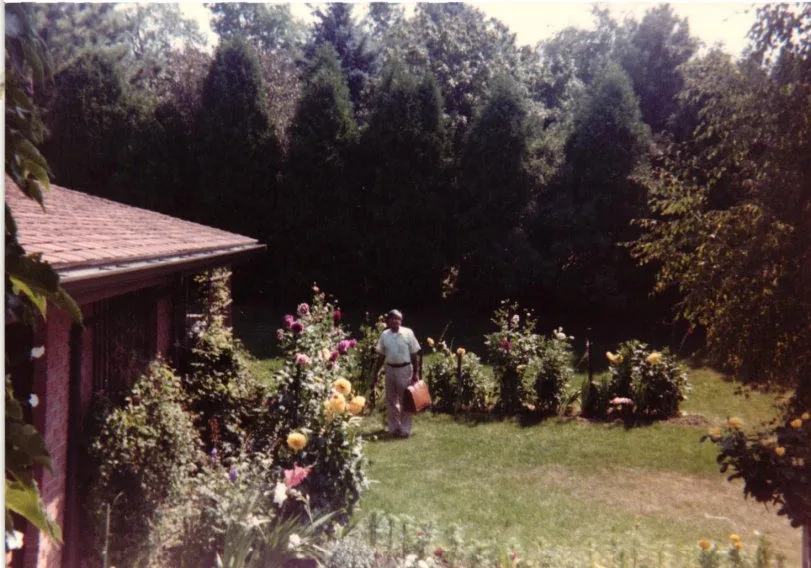
As spring arrived, and while his wife continued to hold court at the kitchen table strewn with crumb-filled dishes and emptied teacups, Mohan labored in the front yard, sweat staining his polyester leisure suit as he created a garden filled with flowers like jewels worn for others to see. Tulips, roses, and then the dahlias took their seasonal stage, their sparkly heads bobbing in the breezy sun or dotting gray skies with spots of color. Mohan sometimes imagined the resplendent blossoms contemplating the grandeur residing within the house they served, humbly accepting their fate as treasures shared benevolently with outsiders in this front garden.
Cars driving around the bend just before 5206 Farmington Lane came into view may have slowed their cars to navigate the turn, but to Mohan, pausing and posing with his wheelbarrow or trowels, it was their admiration slipping into envy that made them tap their brakes and witness the defeat of the green lawns lining the road.
“What a spectacular garden!” How does he do it?” the man behind the wheel would be saying. From the passenger seat, the sprightly wife drawn from American television shows would chide her husband for merely mowing their grass. Mohan would resume his task, satisfied that he had pleased his audience.
On particularly humid weekends when he could delay his return inside no longer, the kitchen fan’s whir would beckon to Mohan, making him forget where he was. As he bent into the fan’s breeze to dry his sweat, the table’s guests would look away in pronounced deference to their sister, making sure she knew they intended to shield her from shame, drawing the siblings’ circle tighter. Their mother, who laid claim to a vaguely referenced regal line, would have admonished Manjit that while gardening was a genteel interest, its actual toil was best left to those who remained unseen. When Hana would timidly approach her father as he tended to his flower beds, Manjit would nervously call her back inside.
Those kitchen table teatimes were now another fading memory. The four siblings were each settling into their own quiet elderly routines, cheerfully dictated by a network of caregivers managed by the Grewal family housekeeper, Ann.
On this afternoon, Manjit sat alone at the dining table, staring down at the computer tablet which Ann had placed in front of her. Before leaving for the day, Ann had tapped on the screen, allowing Manjit to both see and talk to Hana, who now lived in California.
Mohan dozed in the living room’s leather recliner, tending to his dreams, only slightly aware of a conversation taking place over the partial wall.
“Bob, Ann’s son, is helping with the garden. He planted daffodils, but they are wilting now.” Manjit’s back ached as she bent over the screen. Lowering her voice, she added: “Your father is having trouble moving around.” Hana, sitting on her sun-dappled patio, a small, drought-resistant backyard framing her, lowered her voice as well. “Be careful of Ann bringing her family to help you. You shouldn’t just let someone you don’t know come over to the house.”
Hana’s warning kept their conversation chained to their familiar border. As a child, Hana would be warmly called down to the kitchen for tea, but she remained roped off by a language she was never taught. Over weekday dinners with her parents, she ate quietly so that the news anchor on the nearby television could be heard.
Manjit tried to uphold her end of the silent bargain she had made with Hana long ago: Manjit’s heart would remain with her birth family, but her daughter would be free to find her life’s love as she chose. Without comment, Manjit listened politely to Hana’s tales of youth soccer tournaments and the neighborhood book club she had joined with her blue-eyed husband. Yet, the sight of Hana speaking to her from her own home so far away left room for Manjit to imagine being a mother who shares her troubles with her daughter.
Looking at herself in a corner box on the computer screen, Manjit whispered her fear. “The garden will never be the same.” She let her daughter offer ideas for an indoor herb garden on the kitchen windowsill. Manjit held her reply in tears not visible to Hana.
The whimpering daffodils in the front yard made Manjit long for the vain dahlias, for the days when Mohan was the gardener. Through an open kitchen window, she should have called for her husband, beckoning him to her side for another cup of tea. She should have accepted his support like a pillow at her back, allowing herself to relax in her own home instead of eagerly leaning in, untethered and slightly unsure as she glanced around the table lined with her childhood rivals.
The garden no longer belonged to Mohan. Perhaps it should be left alone to overgrow and swallow up its own memory.
After Hana said goodbye and disappeared from view, Manjit woke Mohan from his nap and poured him tea from the teapot Ann had left within reach.
Hana would soon order a bouquet of flowers for her parents from an online florist, making sure that dahlias were included in the arrangement. When the flowers arrived, Manjit would ask Ann to place the vase on the dining room’s half-wall for Hana to see the next time they spoke.
Story complete!
Enjoyed this story? Sign up to like it, save it, and support the author.





Discussion